Blog

  • Review: Down in Flames: Locked-On

    Review: Down in Flames: Locked-On

    DOWN IN FLAMES: LOCKED-ON
    IN THE HANGAR

    Dan Verssen Games (DVG) has long been a true friend to the solitaire wargamer. The “Leader” series, which stretches back to Dan Verssen’s days at GMT Games in 1991 has been a staple of solid, fun games that are fully solitaire, covering everything from World War II fighters (Corsair & Zero Leader) to armored warfare (Tiger and Sherman Leader) to modern jets (Hornet Leader) and ground attack (Thunderbolt-Apache Leader) and the series continues to grow with Stuka Leader having enjoyed a successful Kickstarter campaign earlier this year. And all that is without mentioning the Warfighter Series, the “Commander” series or the more recently added (and outstanding) “Valiant Defense” series. All of ’em – yep, solitaire games.

    And while it may seem like everything in the DVG portfolio is solitaire, that is not the case. Among the many other offerings at DVG is the “Down in Flames” series, which like the Leader series, dates back originally to Dan’s GMT days. The first Down in Flames games were World War II era games and the series focuses on the guns-only, piston-engined dogfighting of that global conflict. This is a series of card-driven games and the back-and-forth between the players is fun and the action quick.

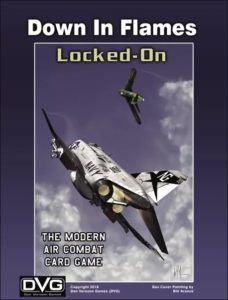
    In 2018, DVG released “Down in Flames: Locked-On” and that game took the DiF series to the Jet Age. Covering conflicts from the Korean War to the Gulf War, the game includes aircraft models from the early days such as the first American and Soviet built jets to the staples of the end of the Cold War era such as the F-14 Tomcat (of the original “Top Gun” fame), the F-15 Eagle (an aircraft I maintained in my Air Force days and for which I therefore have a great affection, and their Soviet/Russian counterparts such as the MiG-29 and Su-27. 

    Yet, because it was a two-player game, I never gave it much of a chance. And when it was released to Kickstarter, not all that many others did either. And that, my friends, was a crying shame because this game is, in a word, awesome. Plus, DVG came up with a creative and easy to use method to play it solitaire, making it an instant classic in my book.

    PAYLOAD

    What’s in the box you might ask? Well, you get a lot, as you might expect in a game covering four-plus decades of aerial combat.

    Specifically, what you’ll find inside the box :

    • The rules, naturally. Short, because the game isn’t overly complicated. The only potential gripe for some is that some aspects of the game aren’t described as thoroughly as you might like, but in my opinion, the rules are well-done and concise.
    • A booklet covering the solitaire system. Like the main rules, this is succinct and gets the job done.
    • 98 Action cards which drive the game and include various tactics as well as determining whether you can fire missiles or guns. 
    • 126 aircraft cards – 2 for each of the 63 jets in the game. Some jets are duplicated – there are multiple versions of my F-15 for example (USAF and Israeli for example) but each has two cards in the set. 
    • A set of 6 campaign cards, each covering a historical conflict such as the aforementioned Korean War and including others like the 1973 Yom Kippur War, the 1982 Falklands War and more.

    What’s not included, and something you’ll need for the solitaire mode, is a single 10-sided die. But if you’re a wargamer, you’ve got plenty of dice around.

    Read more >

  • Patriot League cards for History Maker Baseball

    Patriot League cards for History Maker Baseball

    MEMORIAL DAY 2022

    I created a card set back in 2014 in honor of the 70th anniversary of the Normandy invasion. This set honors the men and women who made the ultimate sacrifice as members of the U.S. Armed Forces in the Second World War. I am re-releasing this card set to remember these brave souls for Memorial Day 2022. 

    This card set is for PLAAY Games’ History Maker Baseball. Each card bears the name of a servicemember who fell in World War II. Please download and enjoy these cards, and while playing, spare a moment to remember the brave souls whose names are printed on the cards.

    Featured Video


  • D-Day At Tarawa Review: One Square Mile of Hell, Indeed

    D-Day At Tarawa Review: One Square Mile of Hell, Indeed


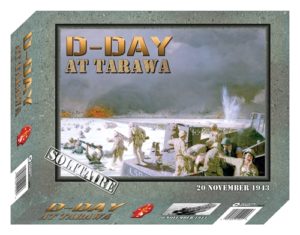
    D-DAY AT TARAWA

    John Butterfield is a designer who is both well-known and beloved by solitaire wargamers. From the classic Ambush! to the soon-to-be released Enemy Action: Kharkov, Mr. Butterfield has delivered a slew of well-imagined solitaire games that are both fun, historically accurate and definitely tough to win.

    This review is on one of these classics – and it’s not a new game. But as they say when you buy a used car, it’s “new to you” and in this case, that’s true for me. My initial foray into the “D-Day at” series which was created by Mr. Butterfield and began with 2009’s D-Day at Omaha Beach. D-Day at Tarawa was the second game in the series, originally released in 2014 with a second edition boasting a mounted map board (among other improvements) followed in 2017. All the “D-Day at” games have been published by Decision Games with Tarawa being followed by Peleliu (2015), Iwo Jima (2018) and the upcoming D-Day at Saipan (scheduled for summer 2022).

    I decided to go with D-Day at Tarawa as my entry point for this series, based on two factors: first, I am a sucker for Pacific Theater games and a Marine Corps fanboy (despite being a USAF veteran) and second, I had read that Tarawa was a better introduction to the series than Omaha Beach. This put in a good spot amongst its “siblings” – Peleliu is considered extremely tough and Iwo Jima, the first in the series not designed by Butterfield, has taken a lot of flak (of the printed variety) for, among other things, its abandonment of the firing “dots” used by Butterfield in the previous entries in the series.

    D-Day at Tarawa currently boasts a solid 8.2 on BoardGameGeek, .1 behind Omaha Beach and Peleliu, but well ahead of the much-maligned Iwo Jima entry (6.9). Having now taken it for a spin, I feel it’s time to provide my thoughts on this classic.

    ONE SQUARE MILE OF HELL

    Tarawa itself is an atoll in the Central Pacific, consisting of several islands, the largest of which is Betio (pronounced Bay-sho) – and it was here that the 2nd Marine Division landed and did fierce battle with the Japanese defenders over three days beginning on November 20, 1943. The invasion was the first in the Central Pacific portion of the U.S. forces’ island-hopping campaign that culminated at Okinawa 19 months later.

    I’d highly recommend for anyone who likes to get to know a game’s setting before playing the book “One Square Mile of Hell” by John Wukovits and also, if you have Amazon Prime, you can watch at no cost the 2005 documentary “As It Happened: Tarawa” which uses archival footage and some interviews with surviving Marines who took part in the battle. 

    The title of Wukovits’ book is an accurate one-sentence descriptor for the battle the 2nd Marine Division faced on Betio. The game does a fantastic job illustrating just how tough this fight was – up to, and beyond (for some) the point of frustration. The frustration is due to the way the game models the difficulty the Marines had just getting to shore, let alone what happened once they did make it onto the beach.

    Read more >

  • Review: The Last Hundred Yards, Volume 3

    Review: The Last Hundred Yards, Volume 3

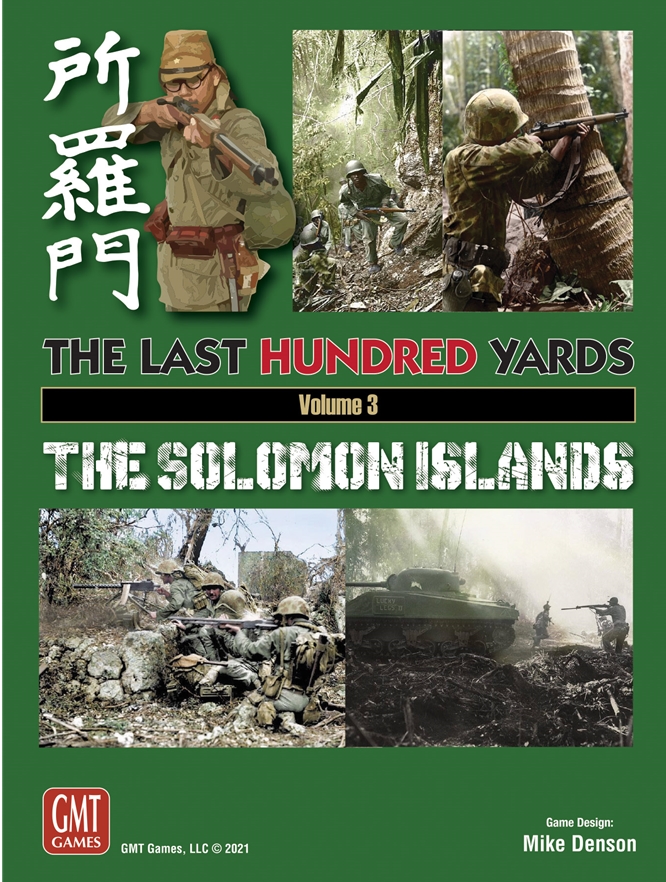
    THE LAST HUNDRED YARDS VOLUME 3

    The tactical, squad-level category is an increasingly crowded one. We have the venerable “grandfather” of tactical games in Advanced Squad Leader, which was an evolution of the much simpler Squad Leader. ASL has a massive following and its DNA is all over many of the tactical games that followed it. But none have really unseated it as the king of the hill for its rabid following (who are vocal and always ready to defend it against the challengers who have cropped up over the years).

    But ASL is an older system and as time goes on, innovation emerges that push the envelope and deliver fresh mechanics that push the tactical genre forward. Games like Conflict of Heroes, Lock N Load Tactical, Combat Commander, Combat Infantry, Old School Tactical (yes, the list is getting long and I’m not including nearly everything) have all earned devoted followings of their own. 

    Into this crowded field a relatively new contender has emerged: The Last Hundred Yards. Designed by Mike Denson and published by GMT Games, LHY (as it will hereafter be called) debuted in 2019. The base game (or volume 1 as some – including me – now call it) featured the U.S. Army and German Wehrmacht in France, following the Normandy landings.

    The base game proved successful and garnered some 2019 Charles S. Roberts Award nominations (though it did not win) and currently boasts an 8.1 score on BoardGameGeek. Fittingly, a follow-up was released in 2020, The Last Hundred Yards Volume 2: Airborne Over Europe. And yes, you guessed it, it featured paratroopers – lots of them, including the two famed U.S. Airborne Divisions: the 101st Screaming Eagles and the 82nd All-American. Volume 2 boasts a slightly better 8.2 rating than its parent game on BGG.

    2021 saw the release of LHY Volume 3: The Solomon Islands, bringing the system to the Pacific Theatre of Operations. It is this third volume that is the subject of this review.

    WELCOME TO THE JUNGLE

    The move to the PTO means the debut of both the U.S. Marine Corps and the Imperial Japanese Army in the LHY series as well as a whole new set of terrain – with jungle being the most frequent (and most obvious). The player in LHY assumes the role, essentially, of a Company commander. Depending on the mission the player will have at their disposal one or more platoons of infantry, various support weapons such as machine guns, mortars and anti-tank weapons (and also possibly some flamethrowers too), and armor as well. Yes, there were tanks in the PTO, including the M4 Sherman, although the Japanese had nothing like what the Germans fielded in the ETO.

    If you’re wondering what’s in the box, I just happen to have done an unboxing article and video here. I talk about the fabulous components there as well – everything in the box is top-notch and the maps (there are eight of them) are fantastic.

    The addition of the Japanese forces to the system brings some new rules. The Japanese were known as fanatical fighters and as designer Mike Denson notes in his design notes, were probably the best light infantry force in the world. They were expert at the type of fighting that would take place on the islands and atolls of the Pacific and gave the Marine Corps and U.S. Army units they faced a brutal and difficult fight, often fighting to the last man. 

    Read more >

  • The Last Hundred Yards Volume 3 Unboxing

    The Last Hundred Yards Volume 3 Unboxing

    THE LAST HUNDRED YARDS

    The third entry in Mike Denson’s squad-level tactical series is now available, bring the action to the PTO. We’ll take a look at what’s in the box. The rundown is below, or you can…

    watch the video

    WHAT’S IN THE BOX?

    • 35-page rulebook (Series Rules version 2.0 – updated version available on GMT website)
    • Several charts at end of Rulebook including a Do-Your-Own sheet for both Europe and Pacific theaters
    • 36-page Playbook featuring illustrated rules examples and several play examples as well as designer notes.
    • Game track with casualty and time tracks for scoring with Sequence of Play and several other play aids printed on it
    • 5 double-sided mission cards, 10 missions in all, bring series mission total to 42.
    • Two identical player aid cards featuring several charts (including terrain effects chart)
    • Four full and one half sheet of die-cut counters and markers
    • Four double-sided mapsheets (11×17 in.), 8 maps in total
    • Four 10-sided dice in green, white, yellow and black

    JOE’S THOUGHTS

    • As is the norm for GMT Games the physical components are all rock solid, well-designed components.
    • Liz Stephanoff’s maps are beautiful, with the hexes being subdued and therefore do not detract from the gorgeous terrain.
    • Counters are thick and large with the necessary information clear and easily readable
    • Designer Mike Denson’s rules are clear and easily digestible, particularly when going through the rule and play examples in the Playbook and his design notes offer a lot of insight into both the design and how to play the game.

    In summary, this looks like another great entry in what is becoming a very strong tactical-level series.


    WATCH THE VIDEO

    Media

    Featured Videos

    Unboxing video of GMT Games’ The Last Hundred Yards Volume 3: The Solomon Islands designed by Mike Denson.

  • Combat! Volume 1 and Volume 2 Dual Unboxing

    Combat! Volume 1 and Volume 2 Dual Unboxing

    Combat! Volume 1 and Volume 2 Dual Unboxing

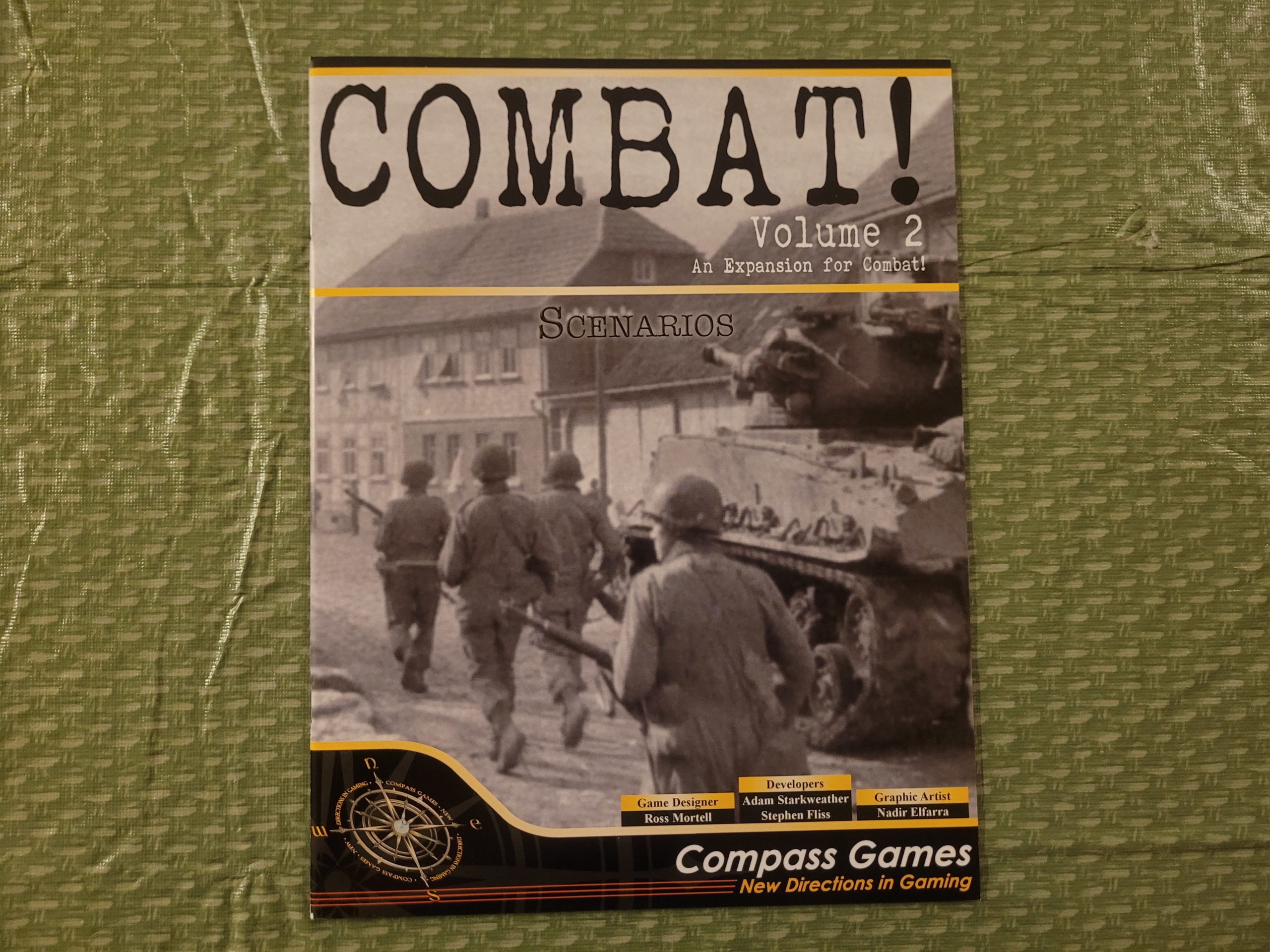
    Game designer Ross Mortell delivers a hefty package of solitaire wargaming in two volumes. The price tag on these games published by Compass Games is on the loftier end of the spectrum. So do these two deliver bang for the buck, component-wise? Let’s find out.

    At the bottom you’ll find the YouTube video of the unboxing of both Volumes 1 & 2.

    Combat! by Compass Games

    What’s in the box(es)

    First things first, these boxes are heavy because they are both p-a-c-k-e-d with stuff.  Compass Games delivers a meaty game and follows it up with a second helping that’s just as jam-packed.


    1. Starting at the top, both volumes contain a rules booklet and a scenario booklet with Volume 2 also adding a Campaign booklet.
    2. Charts are on nice, glossy cardstock and the weapons characteristic charts are really well-done and laid out in a useful, eye-pleasing manner. There are also a couple of play mats, one to track the impulse, initiative and turns and the other for holding the enemy squads and cards for both friendlies and enemies.
    3. The counters are large and thick and printed on both sides. You get more Germans than Americans, although Volume 2 adds an additional squad. 
    4. The unit counters are color-coded by squad, making it easy to identify both your forces and the enemy’s.
    5. The order counters are slightly smaller, making it easy to see the unit counter underneath it, a helpful touch as you can end up with several of these on top of your units.
    6. There are two decks of cards, one for U.S. use and the other for enemy (German) use.
    7. The (thick) paper maps are large and varied and the terrain features are easy to identify. Between the two volumes, there are ten total maps, offering a lot of variety.
    8. Volume 2 adds vehicles and there are nice glossy cardstock sheets with details on each of the vehicles which include tanks (Shermans for the U.S and PzIVs for the Germans), trucks, jeeps and APCs.

    Featured Video

  • Review: Highlight Maker Hoops

    Review: Highlight Maker Hoops

    HIGHLIGHT MAKER HOOPS: Nothin’ but net

    Highlight Maker Hoops

    I’m a big fan of Keith Avallone and PLAAY Games. I have several of Keith’s games, ranging from Second Season Football to History Maker Baseball, Hockey Blast and Red, White & Blue Racing. I love them all so I jumped at the opportunity to pre-order Keith’s latest offering, Highlight Maker Hoops. I am pleased to report that Keith and PLAAY Games have yet another entry in their growing catalog of outstanding games.

    I must admit that there was some trepidation on my part while I (briefly) debated pre-ordering. This was a “highlight” engine and not something that was going to generate a full, or even partial, slate of statistics. Stats are the sine non qua for sports gamers, and I’m no different. However, as I was already fully cognizant of the talent and ingenuity of Mr. Avallone, I felt safe in taking the plunge.

    BOXING OUT

    What’s in the box you might? Well, you get the usual assortment of PLAAY Games goodies, all constructed of their typically solid quality materials.

    Specifically, what you’ll find inside the now-standard colorful PLAAY sleeved box :

    • The always essential, and well-written rules booklet
    • A set of charts for determining the score
    • Two sets of strategy cards
    • A game board with boxes for each team’s lineup and bench, surrounded by the scoring track for each team
    • A double-sided gamer’s aid board with one side for the FAC deck and discards plus three tables and the other side featuring the final minute “minigame” where you can play out the last 60 ticks of the clock using dice and the player cards.
    • A set of player cards covering the final four squads in the most recently completed pro season.
    • A note, hand signed by Keith, with notes about the game. My note, as a pre-order, had tidbits about the use of the strategy cards, which were inadvertently left out of rules booklet. 

    Read more >