Tag: Solitaire

  • In The Trenches: Devil Dogs

    In The Trenches: Devil Dogs

    “RETREAT? HELL, WE JUST GOT HERE!”


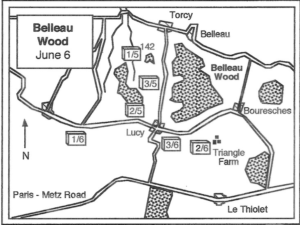
    The famous quote at the top, by Capt. Lloyd Williams, USMC was uttered during the Battle of Belleau Wood where the 5th Marine Regiment, attached to the U.S. Army’s 2nd Division, itself part of the American Expeditionary Force, took on the Kaiser’s Army in the immediate aftermath of the Germans’ 1918 Spring Offensive. The efforts of the 5th and 6th Marine Regiments (collectively the 4th Marine Brigade) in the area of Belleau Wood would add another chapter to the growing legend of the United States Marine Corps. 

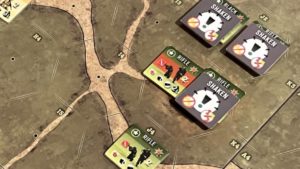
    As the debut game in Tiny Battle Publishing’s version of John Gorkowski’s In the Trenches series (previously published by Grenier Games), In the Trenches: Devil Dogs covers the Marines’ efforts against the Kaiser’s crack troops in those battles during June of 1918, fights that caused the Germans to give the Marines the moniker “Teufelhunden” which translates to, you guessed it: Devil Dogs.

  • Review: ’65: Squad-Level Combat in the Jungles of Vietnam

    Review: ’65: Squad-Level Combat in the Jungles of Vietnam

    65-ANZAC Counters

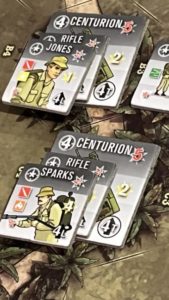
    Some Aussies riding into a VC-controlled village in style on a couple of Centurion tanks
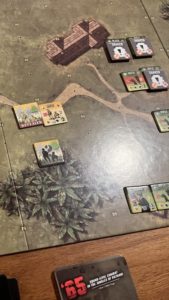
    The solitaire mode is both creative and a challenge. The cards drive the action and determine what the enemy does during its impulse.

    The City map – chock full of tactical opportunities across rice-paddies, cemeteries, large and small buildings, and of course – plain ol’ jungle.

    “I really wanted to do my best Arnold impersonation and bellow ‘Get to the choppahs!’
    – but I restrained myself.”

    SUBHEADING

    TIME TO ROCK IT FROM THE DELTA TO THE DMZ…

    If you don’t recognize the little snippet above, it’s from the 1988 Robin Williams film “Good Morning Vietnam” – and I reference it because just as the words uttered by Williams’ character Adrian Cronauer (a real guy by the way) cover the length of the country of South Vietnam, so does Flying Pig Games’ “’65: Squad-Level Combat in the Jungles of Vietnam” offer a wide-ranging plethora of tactical scenarios during the Vietnam War.

    Designer Mark H. Walker, the man behind Flying Pig Games needs no introduction to grognards. His creds vis-a-vis tactical wargame systems is about as legit as they come. After all, he is the guy behind Lock ‘n Load Tactical, World at War ’85 and Nations at War. He’s also written a bunch of books and now runs two game companies: the aforementioned Flying Pig Games and also Tiny Battle Publishing. 

    The card-driven system Walker employs in ’65 owes its lineage to a game called “Night of Man” which Flying Pig Games released in 2015. That one covered an alien invasion and though I’ve never played it, after playing ’65, it would be safe to say that I am more than a little intrigued about its predecessor.

    The system that drives Night of Man – and ’65 – is as mentioned earlier, card-driven. This strips down the gameplay and makes the game both fast-moving and easily accessible. There aren’t a lot of rules to memorize, and the rulebook itself is short, to-the-point and full of examples that help newbies (or FNGs in Vietnam parlance) get started without too much heartache.

    Generally speaking each side gets a hand of four cards. There are some situations where you might have fewer (or more on at least one occasion). These cards allow actions to be performed. The basics being move and fire, though there are various “types” of actions that cover those two categories (things like Flanking Fire and Fast Move are two of the many examples).

    There are also cards that you can play to support your own action, or if the opponent is playing a card, can allow a reaction to occur. And there are card actions that allow you to rally or reconstitute units that have taken hits in combat. And yes, there is Op fire when a unit passes within the line of sight of a non-phasing unit – as long as you have a fire card.

    The card design is clever and utilitarian, as they typically contain not only two of the action/reaction/support triggers, but also two boxes that will determine the result of combat. Everything from ranged combat, to close assault, to armor and artillery is covered within these two boxes. The cards even determine when a turn ends, as there are four “End of Turn” cards and each scenario will include the number of these cards that will need to be drawn to end each turn.

    Speaking of turns, the game turns feature impulses in which the players will alternate actions with the opponent naturally being able to do things like opportunity fire or play reaction cards. Units will be marked with “Moved” or “Fired” markers after performing one of those actions, or “Ops Complete” if they have done both, or have used a “Power” – another trigger on certain cards.

    Powers – and abilities – are icons on the unit counters. These give variety to the units beyond the typical attack, movement and defense values that most games feature. The powers need to be triggered by the word “Power” on a card, while abilities (in general) are always on. Powers include things like adding firepower to an attack or making an assault more powerful. Abilities will allow units – and heroes – do things like hit multiple targets within a hex, or redraw a card to avoid a bad result, and much more. The variety of abilities and powers really highlights the differences between the units. An NVA rifle squad is not the same as a US Army squad which itself is not the same as a USMC squad, and that goes beyond just the “attack & movement” numbers thanks to abilities & powers.

    The unit mix is very nice too – you get the rifle squads, the machine-guns (M-60s and RPDs), the RPGs, the Sappers, etc. But you also get the heroes mentioned earlier, each possessing a specialized ability (or three) that makes them very valuable. And, it being Vietnam, you also get helicopters. I really wanted to do my best Arnold impersonation and bellow “Get to the choppahs!” – but I restrained myself.  There are two flavors of Hueys – the transport & gunship varieties and the USMC add-on brings some Cobra gunships with a pretty fearsome firepower.

    There are also vehicles – from the tanks (PT-76s for the NVA, M-48s for the US forces and Centurions for the ANZACs), to trucks (some toting guns) to Ontos and M-113 APCs.

    The base game is very good in its own right but when you add the expansions to the mix, the game moves to the level of great. I’m lucky enough to have all the add-ons for this game: Alone in the Jungle (the solo module), the USMC/ANZAC forces and the City map as well as the additional action cards (which add things like ‘Sudden Downpours’ with potentially turn-wrecking consequences).

    The solitaire module is brilliant. It too is card-driven (with its own deck) and the cards, coupled with scenario specific “stances” for the NVA/VC forces, provides a competent opponent. The solo add-on also brings some random events and extra terrain tiles to the mix, as well as six scenarios designed for the solo mode. My opinion, which – full disclosure, I have yet to test – is that the base scenarios could, with a little work, be adapted to work with the solo rules.

    The USMC/ANZAC expansion brings not only the forces of the title organizations, but also new abilities – flamethrowers, anyone? – and powers that really help differentiate the Aussies, the Kiwis and the Corps.

    Then there’s the City map – big, dark and chock full of tactical opportunities thanks to many buildings, rice paddies, cemetery hexes, bridges spanning a river that rolls across the map and even the ubiquitous jungle. I played the city scenario and it was a blast.

    About the only thing missing in this game is air power. Sorry guys, no “Puff the Magic Dragon” or Phantoms laying down some snake n’ nape in this one. But trust me, you won’t even miss ’em.

    To sum up, this is an excellent game. Yes, it’s not new (it was released right around the end of 2016/start of ’17) and to me that makes it feel like a bit of an under-appreciated gem. The card-driven impulse-based system just works. The powers & abilities make the different units feel distinct and the scenarios (especially the solitaire ones) are both fun and filled with little touches that really make the game immersive.

    Technically out-of-print, I couldn’t recommend this more highly. If you like tactical games and can find a copy – get it.

    ReLATED Videos

    Video Series

    ’65: Squad-Level Combat in the Jungles of Vietnam

    The series covers the components, a playthrough of one of the base game scenarios, a demonstration of the solitaire expansion, partial playthrough of the USMC/ANZAC expansion (including armor) and an AAR-type playthrough (with one full turn) of the City scenario, which includes helicopters.

    For full playlist, visit the Hexed & Countered YouTube channel here

  • Review: Down in Flames: Locked-On

    Review: Down in Flames: Locked-On

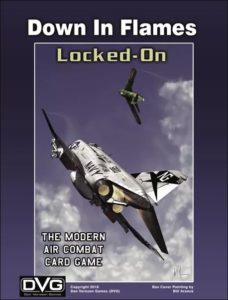
    DOWN IN FLAMES: LOCKED-ON

    IN THE HANGAR

    Dan Verssen Games (DVG) has long been a true friend to the solitaire wargamer. The “Leader” series, which stretches back to Dan Verssen’s days at GMT Games in 1991 has been a staple of solid, fun games that are fully solitaire, covering everything from World War II fighters (Corsair & Zero Leader) to armored warfare (Tiger and Sherman Leader) to modern jets (Hornet Leader) and ground attack (Thunderbolt-Apache Leader) and the series continues to grow with Stuka Leader having enjoyed a successful Kickstarter campaign earlier this year. And all that is without mentioning the Warfighter Series, the “Commander” series or the more recently added (and outstanding) “Valiant Defense” series. All of ’em – yep, solitaire games.

    And while it may seem like everything in the DVG portfolio is solitaire, that is not the case. Among the many other offerings at DVG is the “Down in Flames” series, which like the Leader series, dates back originally to Dan’s GMT days. The first Down in Flames games were World War II era games and the series focuses on the guns-only, piston-engined dogfighting of that global conflict. This is a series of card-driven games and the back-and-forth between the players is fun and the action quick.

    In 2018, DVG released “Down in Flames: Locked-On” and that game took the DiF series to the Jet Age. Covering conflicts from the Korean War to the Gulf War, the game includes aircraft models from the early days such as the first American and Soviet built jets to the staples of the end of the Cold War era such as the F-14 Tomcat (of the original “Top Gun” fame), the F-15 Eagle (an aircraft I maintained in my Air Force days and for which I therefore have a great affection, and their Soviet/Russian counterparts such as the MiG-29 and Su-27. 

    Yet, because it was a two-player game, I never gave it much of a chance. And when it was released to Kickstarter, not all that many others did either. And that, my friends, was a crying shame because this game is, in a word, awesome. Plus, DVG came up with a creative and easy to use method to play it solitaire, making it an instant classic in my book.

    PAYLOAD

    What’s in the box you might ask? Well, you get a lot, as you might expect in a game covering four-plus decades of aerial combat.

    Specifically, what you’ll find inside the box :

    • The rules, naturally. Short, because the game isn’t overly complicated. The only potential gripe for some is that some aspects of the game aren’t described as thoroughly as you might like, but in my opinion, the rules are well-done and concise.
    • A booklet covering the solitaire system. Like the main rules, this is succinct and gets the job done.
    • 98 Action cards which drive the game and include various tactics as well as determining whether you can fire missiles or guns. 
    • 126 aircraft cards – 2 for each of the 63 jets in the game. Some jets are duplicated – there are multiple versions of my F-15 for example (USAF and Israeli for example) but each has two cards in the set. 
    • A set of 6 campaign cards, each covering a historical conflict such as the aforementioned Korean War and including others like the 1973 Yom Kippur War, the 1982 Falklands War and more.

    What’s not included, and something you’ll need for the solitaire mode, is a single 10-sided die. But if you’re a wargamer, you’ve got plenty of dice around.

    Read more >

  • D-Day At Tarawa Review: One Square Mile of Hell, Indeed

    D-Day At Tarawa Review: One Square Mile of Hell, Indeed


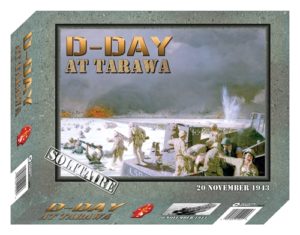
    D-DAY AT TARAWA

    John Butterfield is a designer who is both well-known and beloved by solitaire wargamers. From the classic Ambush! to the soon-to-be released Enemy Action: Kharkov, Mr. Butterfield has delivered a slew of well-imagined solitaire games that are both fun, historically accurate and definitely tough to win.

    This review is on one of these classics – and it’s not a new game. But as they say when you buy a used car, it’s “new to you” and in this case, that’s true for me. My initial foray into the “D-Day at” series which was created by Mr. Butterfield and began with 2009’s D-Day at Omaha Beach. D-Day at Tarawa was the second game in the series, originally released in 2014 with a second edition boasting a mounted map board (among other improvements) followed in 2017. All the “D-Day at” games have been published by Decision Games with Tarawa being followed by Peleliu (2015), Iwo Jima (2018) and the upcoming D-Day at Saipan (scheduled for summer 2022).

    I decided to go with D-Day at Tarawa as my entry point for this series, based on two factors: first, I am a sucker for Pacific Theater games and a Marine Corps fanboy (despite being a USAF veteran) and second, I had read that Tarawa was a better introduction to the series than Omaha Beach. This put in a good spot amongst its “siblings” – Peleliu is considered extremely tough and Iwo Jima, the first in the series not designed by Butterfield, has taken a lot of flak (of the printed variety) for, among other things, its abandonment of the firing “dots” used by Butterfield in the previous entries in the series.

    D-Day at Tarawa currently boasts a solid 8.2 on BoardGameGeek, .1 behind Omaha Beach and Peleliu, but well ahead of the much-maligned Iwo Jima entry (6.9). Having now taken it for a spin, I feel it’s time to provide my thoughts on this classic.

    ONE SQUARE MILE OF HELL

    Tarawa itself is an atoll in the Central Pacific, consisting of several islands, the largest of which is Betio (pronounced Bay-sho) – and it was here that the 2nd Marine Division landed and did fierce battle with the Japanese defenders over three days beginning on November 20, 1943. The invasion was the first in the Central Pacific portion of the U.S. forces’ island-hopping campaign that culminated at Okinawa 19 months later.

    I’d highly recommend for anyone who likes to get to know a game’s setting before playing the book “One Square Mile of Hell” by John Wukovits and also, if you have Amazon Prime, you can watch at no cost the 2005 documentary “As It Happened: Tarawa” which uses archival footage and some interviews with surviving Marines who took part in the battle. 

    The title of Wukovits’ book is an accurate one-sentence descriptor for the battle the 2nd Marine Division faced on Betio. The game does a fantastic job illustrating just how tough this fight was – up to, and beyond (for some) the point of frustration. The frustration is due to the way the game models the difficulty the Marines had just getting to shore, let alone what happened once they did make it onto the beach.

    Read more >

  • Combat! Volume 1 and Volume 2 Dual Unboxing

    Combat! Volume 1 and Volume 2 Dual Unboxing

    Combat! Volume 1 and Volume 2 Dual Unboxing

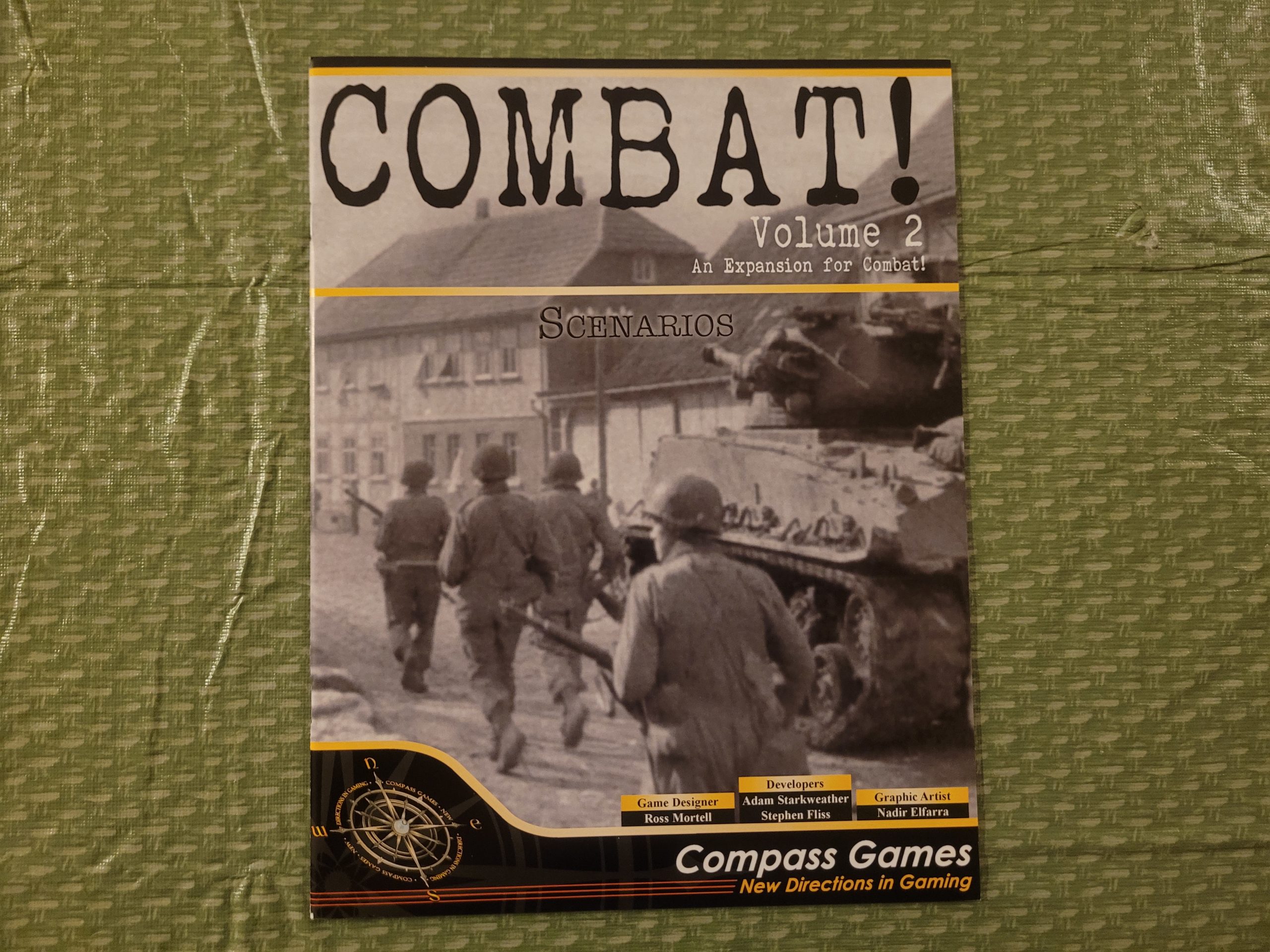
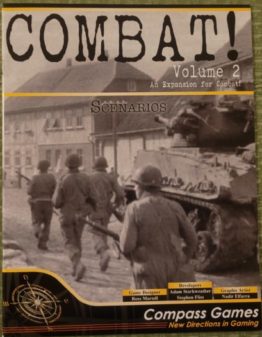
    Game designer Ross Mortell delivers a hefty package of solitaire wargaming in two volumes. The price tag on these games published by Compass Games is on the loftier end of the spectrum. So do these two deliver bang for the buck, component-wise? Let’s find out.

    At the bottom you’ll find the YouTube video of the unboxing of both Volumes 1 & 2.

    Combat! by Compass Games

    What’s in the box(es)

    First things first, these boxes are heavy because they are both p-a-c-k-e-d with stuff.  Compass Games delivers a meaty game and follows it up with a second helping that’s just as jam-packed.


    1. Starting at the top, both volumes contain a rules booklet and a scenario booklet with Volume 2 also adding a Campaign booklet.
    2. Charts are on nice, glossy cardstock and the weapons characteristic charts are really well-done and laid out in a useful, eye-pleasing manner. There are also a couple of play mats, one to track the impulse, initiative and turns and the other for holding the enemy squads and cards for both friendlies and enemies.
    3. The counters are large and thick and printed on both sides. You get more Germans than Americans, although Volume 2 adds an additional squad. 
    4. The unit counters are color-coded by squad, making it easy to identify both your forces and the enemy’s.
    5. The order counters are slightly smaller, making it easy to see the unit counter underneath it, a helpful touch as you can end up with several of these on top of your units.
    6. There are two decks of cards, one for U.S. use and the other for enemy (German) use.
    7. The (thick) paper maps are large and varied and the terrain features are easy to identify. Between the two volumes, there are ten total maps, offering a lot of variety.
    8. Volume 2 adds vehicles and there are nice glossy cardstock sheets with details on each of the vehicles which include tanks (Shermans for the U.S and PzIVs for the Germans), trucks, jeeps and APCs.

    Featured Video