Battle Brothers doesn’t hand you anything. Overhype Studios’ turn-based tactical RPG is a mercenary-company sim where one bad positioning call can cost you a veteran you’ve spent hours leveling, and this episode of the Hexed campaign is a good reminder of why I keep coming back to it.
Grave robbers, Nachzehrers, and early perks
Fresh off sending Hoggart to an early demise the company rides out of Sandheim to deal with grave robbers, which in practice means a scrap with a pack of Nachzehrers: the undead that claw their way up out of the graves and hit harder than their ragged look suggests. Between contracts I spend time on the part of Battle Brothers that quietly matters most: leveling up the brothers and choosing early perks. Those first picks set the tone for a whole campaign, and I talk through why I lean the way I do. A stop in Scharensteyn to recruit fresh blood rounds out the roster before things get messy again.
An ambush and the case for playing cautious
The farmstead is where the episode earns its title. A crumbled-farmstead ambush against brigand thugs is exactly the kind of fight that looks routine and then punishes any brother left standing in the open. Poor Ragan… may his death teach us all not to hang a Brother out to die surrounded by brigands.
Battle Brothers rewards patience, terrain, and a willingness to retreat, and it’s honest enough to let a careless turn end a run. That tension, building renown one survivable contract at a time, is the whole appeal for solo players who like their tactics with consequences.
New episodes of the Hexed campaign land on the channel regularly. Subscribe to follow the company.
Every Battle Brothers campaign starts with optimism and a roster that has no idea what’s coming. This is Episode 1 of the Hexed — a fresh mercenary company in Overhype Studios’ turn-based tactical RPG — and it does not go smoothly, which is exactly why it’s worth watching.
From arena wipe to starting over
The southern city-states and their arenas are a tempting way to make early coin, and they’re also a fast way to lose your whole company if you overreach. We find that out the hard way via an arena wipe early on. With everyone dead, I soldier on… by starting over.
Rebuilding and the first real bounty
With a clean slate, we rebuild the roster, gear up the brothers, and start taking contracts the company can actually survive. The episode’s throughline is hunting down Hoggart the Weasel: a bounty target that gives the young company its first taste of renown. This is the loop that makes the game sing for solo play: recruit, equip, take a job that’s slightly beyond your comfort zone, and see who’s still standing afterward. Consider this the setup; things only get harder from here.
This is the start of the Hexed campaign — more episodes to come. Subscribe to see how far they get.
Squad-level tactical games are relatively plentiful – perhaps more on the tabletop side of the wargaming arena than the PC, but there are a decent number of PC choices as well. MicroProse has entered the fray with a brand-new competitor that hews close to the traditional strengths of the genre as played on the tabletop. That it also nicely leverages the strengths of the PC platform is what makes “Second Front” such an intriguing entry.
The blurb for the game on the MicroProse website does a good job of summarizing just what this game is all about, and the main question you probably would like answered is simple: is the blurb (below) hyperbole, or has designer/developer Jo Bader pulled it off?
Second Front is an accessible WWII turn-based tactical game with more than 40 infantry units and 200 tanks, vehicles and guns. It has all the depth of a paper wargame and the ease of a computer simulation. Campaign, scenarios and a complete editor make it an infinite tactical sandbox experience. (MicroProse.com)
If you’re familiar with tactical wargames on the tabletop (and digital adaptations thereof) then the core gameplay of Second Front is going to be akin to meeting an old friend. The game is an IGOUGO system broken into phases – a system that has been at the core of many tactical wargames going back to the 1980s if not earlier. The phases are:
Move & Fire Phase
Enemy Fire Phase
Escape Phase
Advance Phase
Melee Phase
Recovery Phase
The names might be a little different, but the mechanics will feel like comfy old slippers to grognards. The first phase allows you (and then the AI-controlled enemy) to move, move and fire, or fire. The enemy will be able to take opportunity fire if you enter their line of sight (LOS). See? Familiar territory, and well-implemented here (you’ll be seeing that phrase a lot). The Enemy Fire phase allows you (or the AI) who can still fire (having not taken opportunity shots in the previous phase) may do so, firing at any units in LOS. No movement takes place during this phase. The Escape Phase is automatic – basically any units who have been broken by enemy fire will take this opportunity to run for the hills – and be subject to opportunity fire while doing so. If they can not run & hide they will surrender. The advance phase is also a familiar one from other tactical games: the phasing player’s infantry can move one hex (vehicles can not do this) and by doing so, initiate close combat (aka melee). The melee phase resolves the combat that results from the advance phase placing opposing forces in the same hex. Finally, the recovery phase allows leaders to rally their troops (or, at least attempt to do so), units with broken weapons/vehicles to repair them, etc. This ends the phasing player’s turn and if they are going first, the turn continues with the opposition’s turn – otherwise a new turn is begun.
The learning curve on this game will likely vary based on the player’s experience with tactical games. Because real-life tactics work: find your enemy (some of them will be hidden), fix him by fire, close in and assault. That’s easier said than done, of course, but that’s true of every competent tactical game out there. The game presents a lot of information to the player and understanding all of that, and how it impacts the chances of success for your actions, is probably where the biggest learning curve will come.
Luckily the game comes with a series of 12 infantry and 7 vehicle-specific tutorial scenarios which do an excellent job of giving the player the needed background on how things work in the game. After that, you can fight through the 48 stock scenarios covering battles of American forces vs German forces, Russian forces vs the Germans and vice-versa (12 each of US vs Germany, USSR vs Germany and Germany vs each of the Allied forces). The British, the Commonwealth forces, the French, Italians and all the other combatants are not present in the game, leaving plenty of room for future expansions.
The included scenarios unlock as you win them – at start you will have access to the first two scenarios for each matchup (8 in all). As you win those, more will be unlocked until eventually all 48 are available. There are also five campaigns included, which are a series of linked scenarios. You unlock those as well by winning specific sets of the 48 scenarios. The areas covered vary from Barbarossa’s early days, to combat in Italy by the US 5th Army, to D-Day, Stalingrad, Berlin and more. There is a ton of content in the base game – and with the Steam workshop, even more is available thanks to the game’s built-in map, scenario and campaign editor.
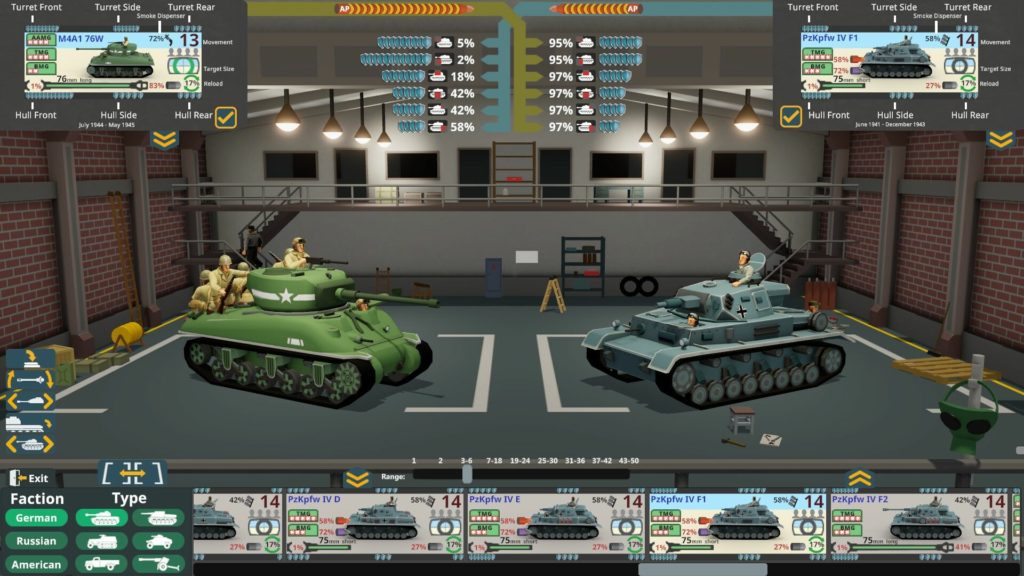
The “Garage” allows you to view the various vehicles and their capabilities.
A TACTICAL SANDBOX
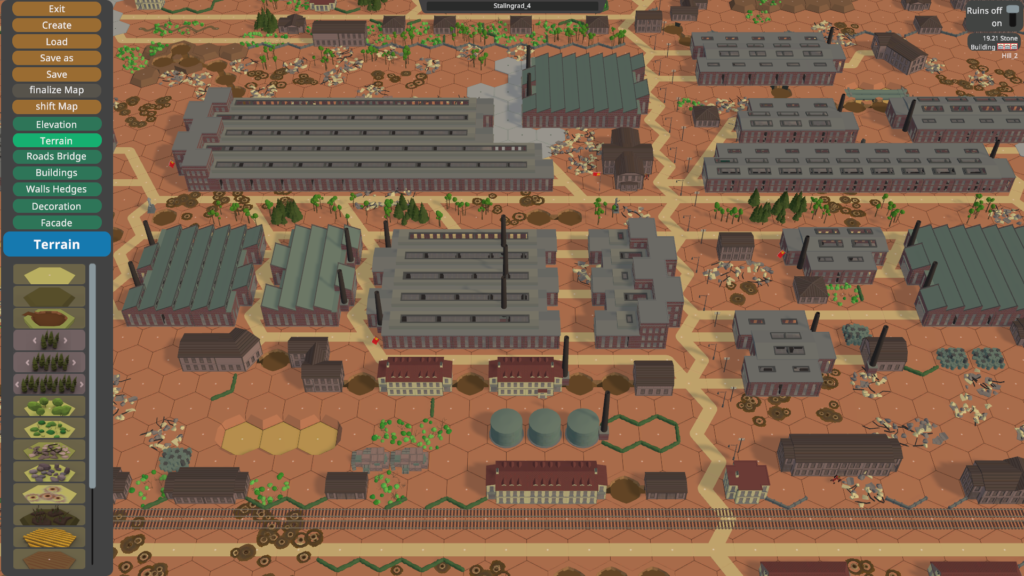
The editing capabilities in this game are excellent. It includes a wide variety or terrain (with various elevations), roads, bridges and railroads, buildings (over 140 varieties of building tiles), walls, hedges, flags, statues, signs and even period posters you can stick on walls. This may appeal to those who enjoy tabletop miniatures as it really captures that feeling of building out the battlefield for specific campaigns or scenarios. And it all works very well, both at the design level and in gameplay.
At the time I’m writing this, the game has not yet released and there are already over 40 scenarios on the Steam Workshop for the game as the content creators are already hard at work adding even more gameplay.
I would like to note here that the game’s aesthetic is very nice. You can zoom in and look inside buildings, or get super close to the units and see the individual soldiers. It’s a very cool feature.
The map editor is a miniature wargamer’s dream.
BOTTOM LINE – IS IT ON TARGET?
MicroProse really has a winner here. This game has everything you’d want from a tactical wargame, particularly if you enjoy a tabletop-like experience. From the hex-based map to the line of sight rules, to the variety of terrain and cover effects and the letter-perfect implementation of the various vehicles and weapons, Second Front really hits on all levels. The graphics are nice and helps reinforce that tabletop miniatures aesthetic. The game also leverages the power of the PC to make it all work. I played well over 30 hours before writing this review and experienced no crashes and no bugs or glitches either. This is an extremely well-designed and well-implemented wargame.
Unsurprisingly based on the paragraph above, this one is a definite recommend from me. If you enjoy wargames, this game is an outstanding addition to the genre.
ReLATED Videos
Video Series
Second Front
Videos on the PC game “Second Front” from MicroProse
Once upon a time, in the distant era remembered by some as “the Nineties” there was a game called “Master of Magic” that became a cult classic of 4X gaming. That game has been updated to the standards of modern gaming by MuHa Games and published by Slitherine – it is this remake of the classic (originally released in 1994) that is the subject of this review.
The game is an interesting combination of a strategy game (that ol’ 4X, you know) and a role-playing game in a fantasy setting where you take on the role of one of 14 stock wizards with diverse backgrounds who compete to dominate the linked worlds of Arcanus and Myrror. Each wizard can cast spells from one or two of several different schools of magic and command a nice variety of fantasy races while they race to expand their power and control over the world.
The bottom line for those whose attention span might not warrant a complete read is that if you enjoyed the original, you will enjoy the remake just as much – and possibly more. And if you’re a fan of 4X type games, it’s likely you’ll find this to your liking as well.
The game, according to Slitherine’s website, is tagged:
“Take up the role of a great wizard, wield powerful spells, command fantasy races and challenge your rivals in this remake of a cult turn-based strategy classic. Do you have what it takes to become Master of Magic?”
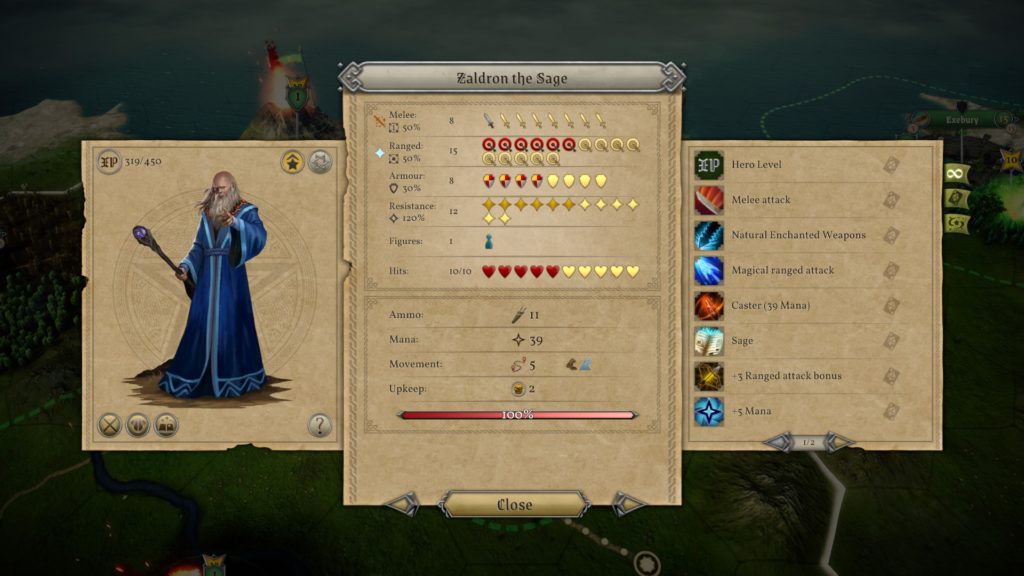
Zaldron the Sage, leveled up to “Lord” and something of a badass…
GAMEPLAY
The core gameplay of “Master of Magic” should be familiar to fans of the 4X genre. It’s fairly stock in that regard: it’s an empire-builder that takes place on a map that is itself split into the realms of Arcanus and Myrror and where you’ll build your cities, do your exploring and move your armies. The game also has a separate battle mode with a zoomed-in map where your units will take on the opposition in a tactical faceoff. This is true whether the opposition is a neutral faction, some monsters guarding a treasure horde (or a well of all-important “mana”), or in the toughest case, an opposing wizard’s forces.
The learning curve on this one can be a little tough. For one thing the AI is no joke – it does a nice job of expanding its territories, upgrading its magical arsenal and producing a roster of units that can give you an old fashioned whuppin’ if you fail to keep up. The central, key element to everything is the diversity of the game in its roster of races, units and most of all spells. You can go into battle thinking that you’ve hit upon a successful formula only to find out that the units you’re facing are immune to the spells you used in your last fight, and what’s more, they have some spells of their own that end up decimating your precious heroes and units. There’s nothing quite so frustrating as taking a hero you’ve painstakingly built up to an epic level and have him be wiped out by the opposing wizard’s undead beetle cavalry amped up on some particularly nasty death magic.
You will need to marshal your forces, build up a stockpile of both gold and mana (the currency of magic) and know how to best employ both to fit out your units and in the case of mana, wield your magical powers upon the world at large. The unit mix is fairly standard, but the variety of races gives some units an edge even with an archetype. Every race might have a swordsmen unit, but they’re not all created equal.
All of this does of course provide you with a plethora of options when it comes to replaying the game. Played as Merlin and got wiped out? Try Horus… or Ariel… or any one of the other ten or so wizards, each with their own strengths and weaknesses. Eventually you might figure out how to become a arcane powerhouse by hitting on the perfect mix of spells and units, but it’s likely to take a lot of effort and frustratingly tough fighting to obtain that information.
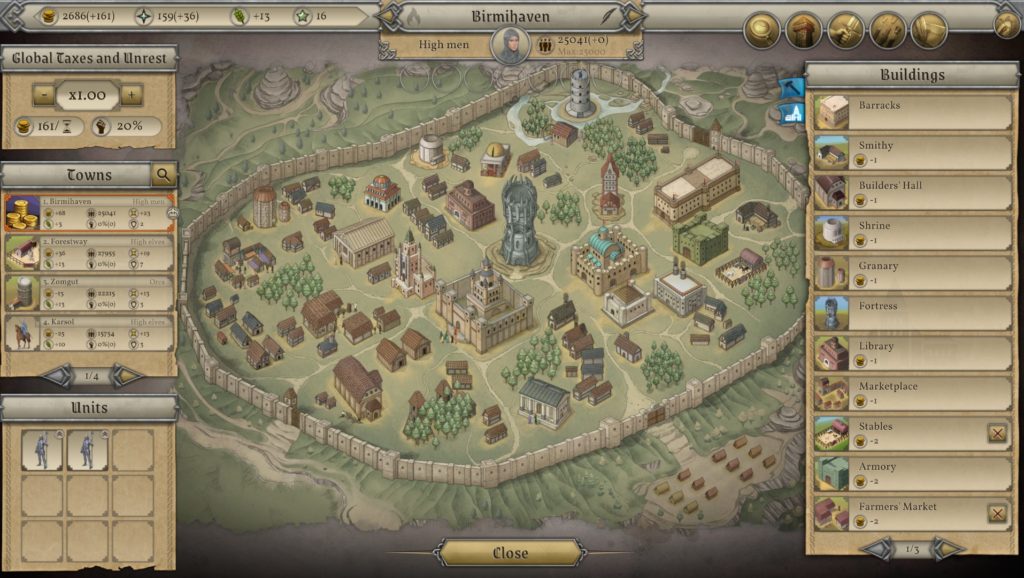
Birmihaven, capital of Merlin’s empire, showing the completed buildings
HEXED… OR BLESSED?
Bottom line? This is an update of a classic that is extremely well-executed. The game is engaging and tough enough to be challenging without becoming frustrating. It also offers a plethora of that much-beloved “replayability” – the sheer diversity of the magic, the units and the wizards (and yes, you can craft your own arcane master) means you can go at it again and again on new maps with new experiences.
Some may take issue with a somewhat slavish adaptation of the old 1994 game – perhaps some additions to take even more advantage of the technological leaps made in video gaming over the past 28 years would have been nice. But that’s nitpicking and I can’t really come up with a specific improvement that I’d like to have seen in this release. According to Steam I have nearly 50 hours into the game already and will likely have many more before all is said and done.
I give this one a hearty recommendation to fans of the 4X genre. There’s a lot of room for new content here too and I hope that MuHa and Slitherine do produce some DLC content to keep growing the game. The game itself is available on the Slitherine website and also on Steam.