Tag: GMT Games

  • Cuius Regio: The Thirty Years War (GMT Games) — First Look & Overview

    Cuius Regio: The Thirty Years War (GMT Games) — First Look & Overview

    The Thirty Years’ War is one of the hardest subjects in the hobby to game well — three decades of shifting alliances, religious fracture, and armies that melted away as fast as they were raised. Cuius Regio: The Thirty Years War (1618–1648), designed by Francisco Gradaille for GMT Games, takes it on at the operational level, spread across the whole Holy Roman Empire on a two-map layout. This first look opens the box and walks through what you’re actually signing up for.

    What’s in the box

    There’s a lot here. I work through the rulebook, the scenario book, the player screens and army holding mats, the player aid cards and tables, and the counter sheets before laying out both the northern and southern maps of the Empire. The scenario range is the real story: you can start small with the Bohemian Revolt or commit to the full Grand Campaign, which GMT pegs in the 30-to-40-hour range. That spread means the box has to serve both the player who wants a single evening and the one chasing the whole war, and a first look is where you start to judge whether the components and structure can carry that weight. The presentation is up to GMT’s usual standard, but production is never the whole story — the real test is how the sequence of play, movement, and combat hold up once the counters start moving, and that’s the question I carry into the gameplay videos.

    First looks here always lead into full playthroughs. Subscribe so you don’t miss this one on the table.

  • Cuius Regio: The Thirty Years War (GMT Games) — Scenario 1: 1618 Turn Gameplay

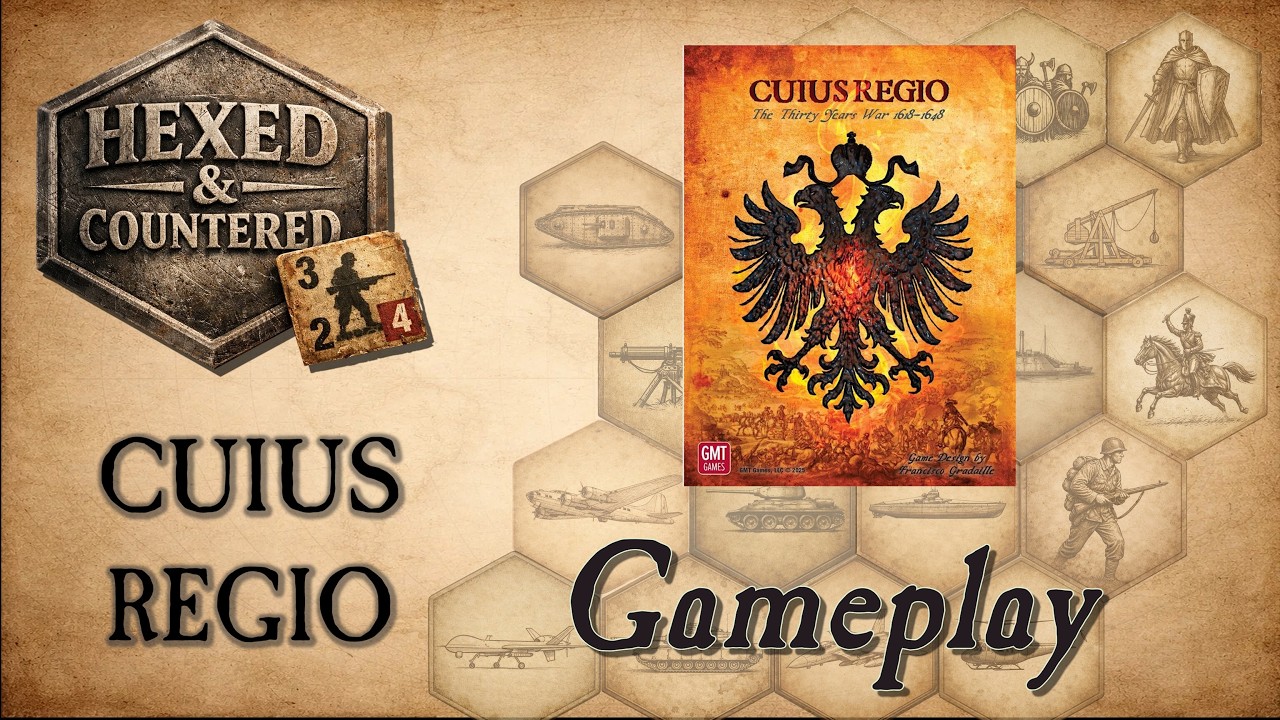
    Cuius Regio: The Thirty Years War (GMT Games) — Scenario 1: 1618 Turn Gameplay

    A first look tells you what’s in the box; the gameplay tells you whether the system holds together once the counters are on the map. This is Scenario 1 of Cuius Regio: The Thirty Years War, Francisco Gradaille’s operational-level design for GMT Games, played at the table — and it drops you straight into 1618, where the whole conflict began.

    The war’s first crisis, 1618

    Scenario 1 is the natural entry point into a game that can otherwise stretch to a 30-to-40-hour grand campaign. Starting in 1618 means starting with the Empire already fracturing along religious and political lines, and this playthrough works through the opening turn to show how Cuius Regio handles movement, army management, and the sequence of play at a scale that spans the whole Holy Roman Empire. Rather than front-loading every rule, I let the turn structure explain itself as it comes up, so you can see where the friction actually is — how far forces really reach, what a combat costs you, and how quickly a promising position can come apart. I covered the components and rules in the first look; this is the design in motion, and it’s the honest test of whether it earns the table time it asks for.

    The campaign continues from here. Subscribe so you don’t miss the next scenario on the table.

  • Atlantic Chase Review – An Innovative Naval Wargame

    Atlantic Chase Review – An Innovative Naval Wargame

    ATLANTIC CHASE REVIEW

    This is the Hexed & Countered review of the 2nd printing of the game Atlantic Chase, designed by Jerry White and published by GMT Games. The game debuted in 2021 and quickly sold out, a sure sign of a good game. It took under two years for a P500 reprint to appear, which is something of a “blink of the eye” in P500 terms (some of those can run a lot longer, to the frustration of many a grognard). I was one of the P500 backers and was thrilled to finally get the game in my hands. After playing it, I’m ready to provide a review and if you’re one of those “Too long, didn’t read” types, the bottom line is that this is a fantastic game.

    First, a little background: Atlantic Chase is an operational-level game of – you guessed it – the Battle of the Atlantic during the Second World War. It pits the British Royal Navy against Germany’s Kriegsmarine. The focus is on the surface forces; British submarines, German U-Boats and both sides’ air assets all play a role, but that role is decidedly one of support and not a starring role.

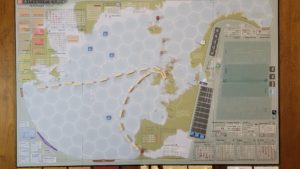
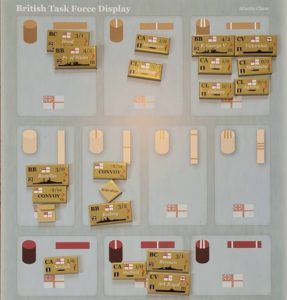
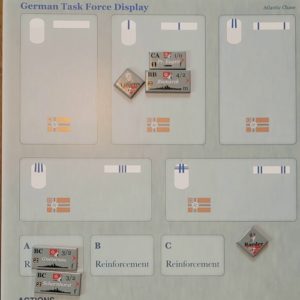
    The map is a large, hex-based map covering the North Atlantic from the coast of North America to the western Baltic and from the Arctic Circle to the fringes of the South Atlantic – which covers a lot of open water. One of the first things that show Jerry White’s innovative design is that the game’s primary counters – the ships themselves – do not live on the map but rather on task force displays, 8.5 x 11 inch cards. The British card has space for ten task forces and each has a color and a band on it to identify that task force while the German display has space for five task forces. Both sides’ displays also include reinforcement boxes.


    INNOVATIVE FOG-OF-WAR

    So what is on the map? Wooden bits – cylinders and then rectangular blocks – represent the task forces on the map. The cylinders are called “stations” and represent a ship’s known location in space & time. That is, we – both players – know that this task force (which can be one ship or several) is in that hex. The rectangular pieces are trajectory segments and this is where that innovation really becomes apparent. Trajectories represent a “we know the task force is somewhere along this path, but are uncertain where exactly that is” – it’s fog-of-war but in a new way based on the concept of a string on a map in a war room, perhaps one where Churchill stares at it in his inimitable bulldogish way, cigar clamped between his teeth. And that string? It not only represents the enemy’s ships, but also your own. It is a rather clever way to provide limited information to the player while still allowing the player to plan and act on said information.

    Key to this is the length of the trajectory – longer means you have less idea where the task force actually is – shorter means your information is getting better. This impacts the actions you take upon the trajectories with actions involving longer trajectories being more apt to be unsuccessful. Actions involving forces with shorter trajectories, or better yet, stations with a known location, are much more likely to be successful.

    OUT THERE… SOMEWHERE

    There are nine possible actions that you can take – when you have initiative, that is. These run the gamut from utilizing air and stealth forces like submarines and mines to searching for the enemy, attempting to engage the enemy or just “completing” a trajectory to get it safely into port. Setting up for, and using these actions correctly are absolutely vital to success. Yes, you need to roll dice ultimately as is the case in many wargames, but your chances are significantly improved by performing actions in the right sequence, at the right time and on the right trajectories to get the result you’re seeking. Every action is harder when employed on long trajectories and easier to successfully pull off when the trajectories are short. And you can shorten trajectories in a variety of ways, most of which also have the side effect of shortening your own trajectories, which makes the enemy’s information more precise and therefore more advantageous. Initiative changes in a variety of ways, depending on the actions the player currently holding it takes. And it is important because as the inactive player, you are limited in what you can do and sometimes have to watch as your enemy hones in an all-important task force, wrecking your plans. All in all, this is an extremely clever system.

    You’ll end up with trajectories crossing each other – or at least intersecting – as you attempt to nail down the enemy while hopefully not getting yourself in a bind doing so. For the Germans this is often a precarious task. The Kriegsmarine has limited resources and needs to be both bold and careful, which is a tightrope act of the first magnitude. The Royal Navy’s task isn’t easy either, it has convoys to protect and they are often vulnerable with rules that (rightly) prevent the player from loading up a convoy with an escort of big, powerful ships – in most cases you’re limited to one ship as an escort and this can range from a destroyer squadron to a battleship (or even potentially an aircraft carrier though that in itself would be risky).

    The game does an excellent job of portraying the real-life cat and mouse nature of the Battle of the Atlantic. There are mechanics for intel, evasive action, contact between forces that proves indecisive. The battle game is fairly simple, but mechanically sound and for those who want more meat on the bone, there is a set of advanced battle rules that make things more realistic.


    SCENARIOS GALORE

    The folks who will be interested in this game are likely familiar with the real-life history of this battle, the chase and sinking of German raiders such as the Graf Spee and the most famous of all, the search for, and ultimate destruction of, the Bismarck. And yes, there are scenarios that feature both the Graf Spee and the Bismarck. The game includes a slew of scenarios covering the course of the war from the early days of September 1939 when the British and French fought together all the way through the year 1942 when France was occupied and the Soviet Union and United States had joined the Allied cause and Britain no longer fought alone. There are solitaire scenarios, two-player scenarios and even a campaign game where you build and marshal your forces, with things carrying over from operation to operation (each operation in the campaign typically covers one year, with their being two of them later in the war).

    For the solo player, this is a real gold mine. Not only is there a booklet full of solitaire scenarios, but each has a crafted AI “bot” which utilizes tables and scenario specific rules to manage the enemy forces, but all of the two-player scenarios and campaign are also eminently playable solitaire. Just simply manage both sides to the best of your ability – something most of us have done many times.


    THE BOTTOM LINE

    In summation, I can not recommend this game highly enough. It does an incredible job of managing the uncertainty, or “fog of war” of the Battle of the Atlantic in a fresh and innovative way that simply works. Weather plays a role, utilization of support assets is important and making the right decisions with your forces is crucial.
    Atlantic Chase - The Main Board

    British Task Force Display

    German Task Force Display


    ATLANTIC CHASE Videos

    Videos on ATLANTIC CHASE from GMT Games

    A first look video and two playthrough videos.


  • Review: Carrier Battle: Philippine Sea

    Review: Carrier Battle: Philippine Sea

    A SOLITAIRE WARGAME Direct Hit


    Carrier Battle: Philippine Sea is a fantastic solitaire wargame that offers a challenging and immersive gameplay experience. Designed by Jon Southard, this game is a sequel to the venerable & popular Carrier from Victory Games which was released back in 1990, but with a focus on the historic battle of the Philippine Sea. One of the strengths of the game is how it breaks down its mechanics into manageable pieces through programmed learning, making it accessible for players to learn and master.

    The game’s scenario booklet provides a tutorial-style approach, with the first five scenarios serving as tutorials that introduce players to different aspects of the game mechanics. For example, in scenario one, players learn the rules of air-to-air combat through an interception of incoming Japanese planes by US fighter planes. This approach of breaking down the core mechanics into separate scenarios makes it easier to understand and learn the game as a whole.

    One of the core mechanics of the game is carrier flight deck operations, which is covered in scenario three. Managing the carriers correctly, including ensuring the right aircraft are on deck and ready for launch, becomes crucial for success in the game. Players need to carefully plan and execute their carrier operations, as the enemy attacks in waves and can cause damage or loss to the carriers if not managed effectively. This adds depth and strategy to the gameplay, making it engaging and challenging.

    Search and location of enemy task forces are also important aspects of the game, as covered in scenario four. The game provides different levels of intelligence on enemy forces, and players need to carefully plan their search and detection strategies to locate and engage the enemy effectively. This adds a layer of realism and decision-making to the gameplay, keeping players engaged and strategizing throughout the game.

    The rule book of the game may be lengthy, but the game’s mechanics are reasonably straightforward and easy to understand. The programmed learning approach used in the tutorial scenarios helps players grasp the different aspects of the game gradually, making it accessible to both experienced wargamers and newcomers to the genre.

    The post-tutorial scenarios offered in the game include individual scenarios for both days of the battles, a full-on two-day scenario and an alternate history offering called the “Great Battle of the Pacific” that includes ships that had been sunk in earlier fighting and also boosts the performance of the Japanese aircrew, which had by this time been severely diminished in skill due to pilot losses. The game also features a detailed and immersive setup of enemy forces, Butai displays, and management of Japanese carriers, adding depth and complexity to the gameplay.

    The game also includes US submarines, which played a vital role in the battle as well as rules for surface battles – part of the American Task Force 58 included Task Group 58.7 which was the battle line group and featured iconic ships such as the USS Iowa, while the Japanese forces included the Yamato, the largest battleship in the world.

    In summary, Carrier Battle: Philippine Sea is a well-designed solitaire wargame that offers a challenging and immersive experience. The programmed learning approach, manageable pieces of mechanics, and strategic depth make it enjoyable to play and learn. Whether you are a seasoned wargamer or new to the genre, this game is a must-try for any fan of tabletop wargames.

    Featured Videos

    Video content for Carrier Battle: Philippine Sea from the Hexed & Countered YouTube channel.


  • Review: The Last Hundred Yards, Volume 3

    Review: The Last Hundred Yards, Volume 3

    THE LAST HUNDRED YARDS VOLUME 3

    The tactical, squad-level category is an increasingly crowded one. We have the venerable “grandfather” of tactical games in Advanced Squad Leader, which was an evolution of the much simpler Squad Leader. ASL has a massive following and its DNA is all over many of the tactical games that followed it. But none have really unseated it as the king of the hill for its rabid following (who are vocal and always ready to defend it against the challengers who have cropped up over the years).

    But ASL is an older system and as time goes on, innovation emerges that push the envelope and deliver fresh mechanics that push the tactical genre forward. Games like Conflict of Heroes, Lock N Load Tactical, Combat Commander, Combat Infantry, Old School Tactical (yes, the list is getting long and I’m not including nearly everything) have all earned devoted followings of their own. 

    Into this crowded field a relatively new contender has emerged: The Last Hundred Yards. Designed by Mike Denson and published by GMT Games, LHY (as it will hereafter be called) debuted in 2019. The base game (or volume 1 as some – including me – now call it) featured the U.S. Army and German Wehrmacht in France, following the Normandy landings.

    The base game proved successful and garnered some 2019 Charles S. Roberts Award nominations (though it did not win) and currently boasts an 8.1 score on BoardGameGeek. Fittingly, a follow-up was released in 2020, The Last Hundred Yards Volume 2: Airborne Over Europe. And yes, you guessed it, it featured paratroopers – lots of them, including the two famed U.S. Airborne Divisions: the 101st Screaming Eagles and the 82nd All-American. Volume 2 boasts a slightly better 8.2 rating than its parent game on BGG.

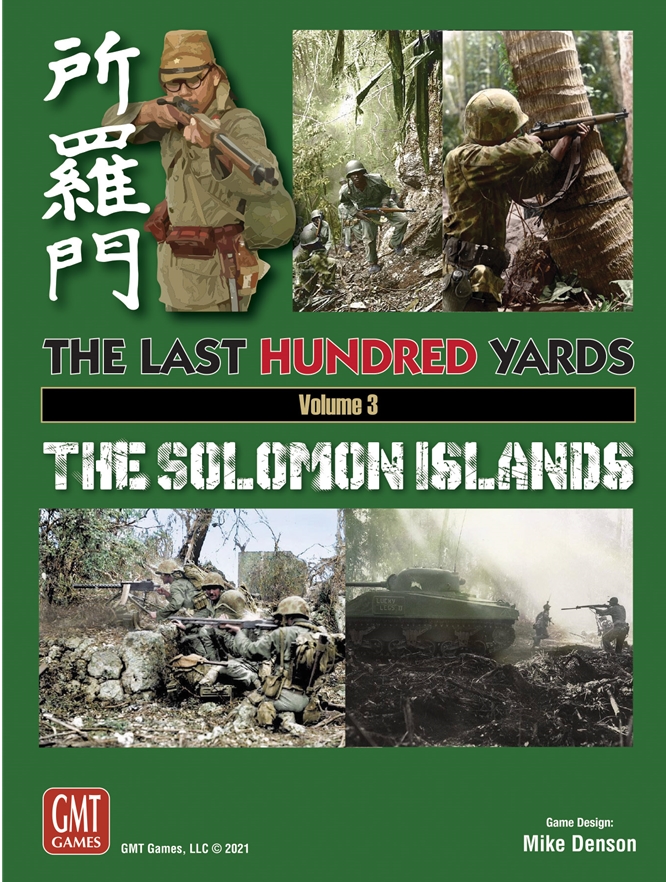
    2021 saw the release of LHY Volume 3: The Solomon Islands, bringing the system to the Pacific Theatre of Operations. It is this third volume that is the subject of this review.

    WELCOME TO THE JUNGLE

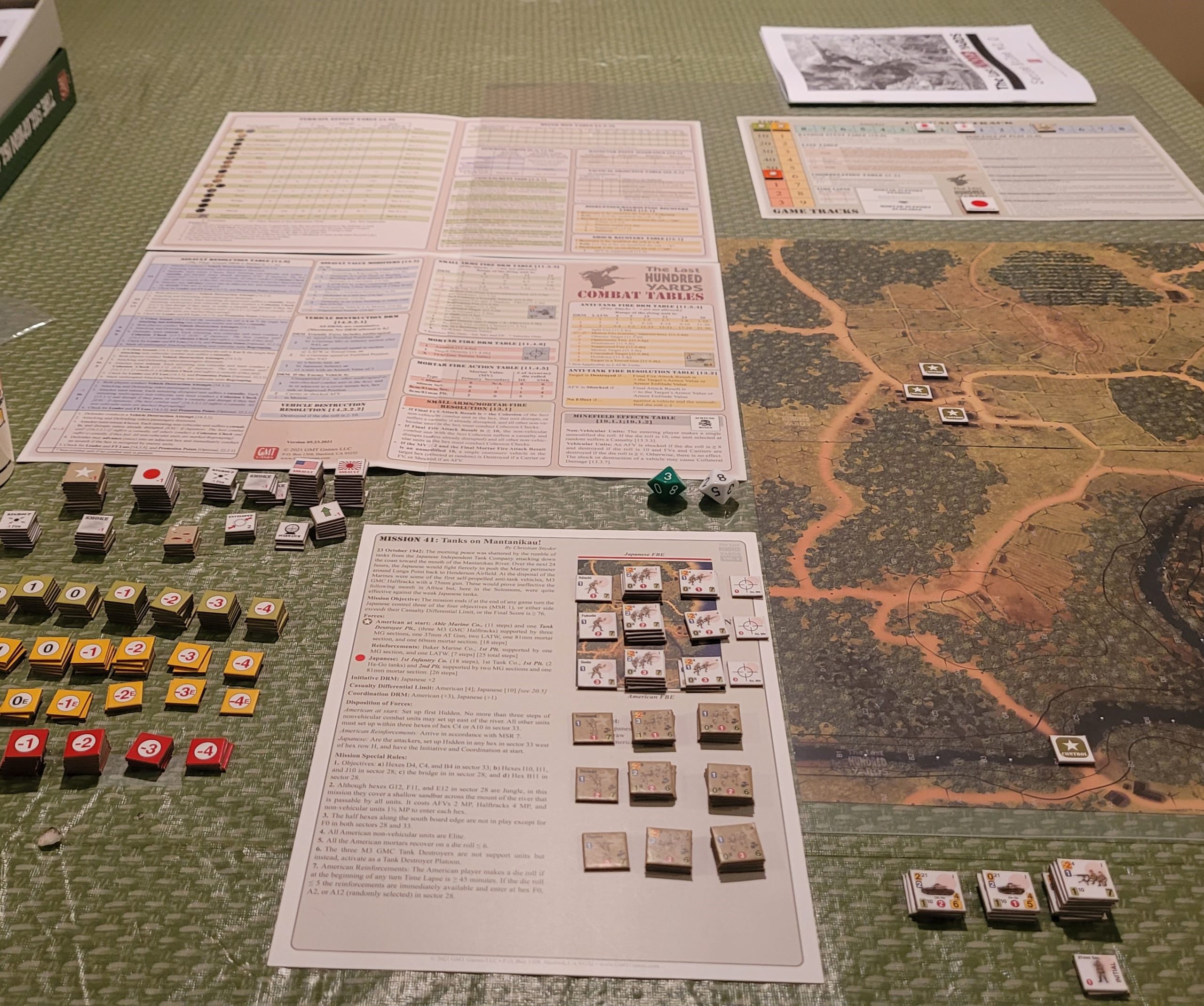
    The move to the PTO means the debut of both the U.S. Marine Corps and the Imperial Japanese Army in the LHY series as well as a whole new set of terrain – with jungle being the most frequent (and most obvious). The player in LHY assumes the role, essentially, of a Company commander. Depending on the mission the player will have at their disposal one or more platoons of infantry, various support weapons such as machine guns, mortars and anti-tank weapons (and also possibly some flamethrowers too), and armor as well. Yes, there were tanks in the PTO, including the M4 Sherman, although the Japanese had nothing like what the Germans fielded in the ETO.

    If you’re wondering what’s in the box, I just happen to have done an unboxing article and video here. I talk about the fabulous components there as well – everything in the box is top-notch and the maps (there are eight of them) are fantastic.

    The addition of the Japanese forces to the system brings some new rules. The Japanese were known as fanatical fighters and as designer Mike Denson notes in his design notes, were probably the best light infantry force in the world. They were expert at the type of fighting that would take place on the islands and atolls of the Pacific and gave the Marine Corps and U.S. Army units they faced a brutal and difficult fight, often fighting to the last man. 

    Read more >

  • The Last Hundred Yards Volume 3 Unboxing

    The Last Hundred Yards Volume 3 Unboxing

    THE LAST HUNDRED YARDS

    The third entry in Mike Denson’s squad-level tactical series is now available, bring the action to the PTO. We’ll take a look at what’s in the box. The rundown is below, or you can…

    watch the video

    WHAT’S IN THE BOX?

    • 35-page rulebook (Series Rules version 2.0 – updated version available on GMT website)
    • Several charts at end of Rulebook including a Do-Your-Own sheet for both Europe and Pacific theaters
    • 36-page Playbook featuring illustrated rules examples and several play examples as well as designer notes.
    • Game track with casualty and time tracks for scoring with Sequence of Play and several other play aids printed on it
    • 5 double-sided mission cards, 10 missions in all, bring series mission total to 42.
    • Two identical player aid cards featuring several charts (including terrain effects chart)
    • Four full and one half sheet of die-cut counters and markers
    • Four double-sided mapsheets (11×17 in.), 8 maps in total
    • Four 10-sided dice in green, white, yellow and black

    JOE’S THOUGHTS

    • As is the norm for GMT Games the physical components are all rock solid, well-designed components.
    • Liz Stephanoff’s maps are beautiful, with the hexes being subdued and therefore do not detract from the gorgeous terrain.
    • Counters are thick and large with the necessary information clear and easily readable
    • Designer Mike Denson’s rules are clear and easily digestible, particularly when going through the rule and play examples in the Playbook and his design notes offer a lot of insight into both the design and how to play the game.

    In summary, this looks like another great entry in what is becoming a very strong tactical-level series.


    WATCH THE VIDEO

    Media

    Featured Videos

    Unboxing video of GMT Games’ The Last Hundred Yards Volume 3: The Solomon Islands designed by Mike Denson.