Author: Hexed & Countered

  • Fallschirmjäger: The Airborne Assault on Fortress Holland (MMP) — First Look

    Fallschirmjäger: The Airborne Assault on Fortress Holland (MMP) — First Look

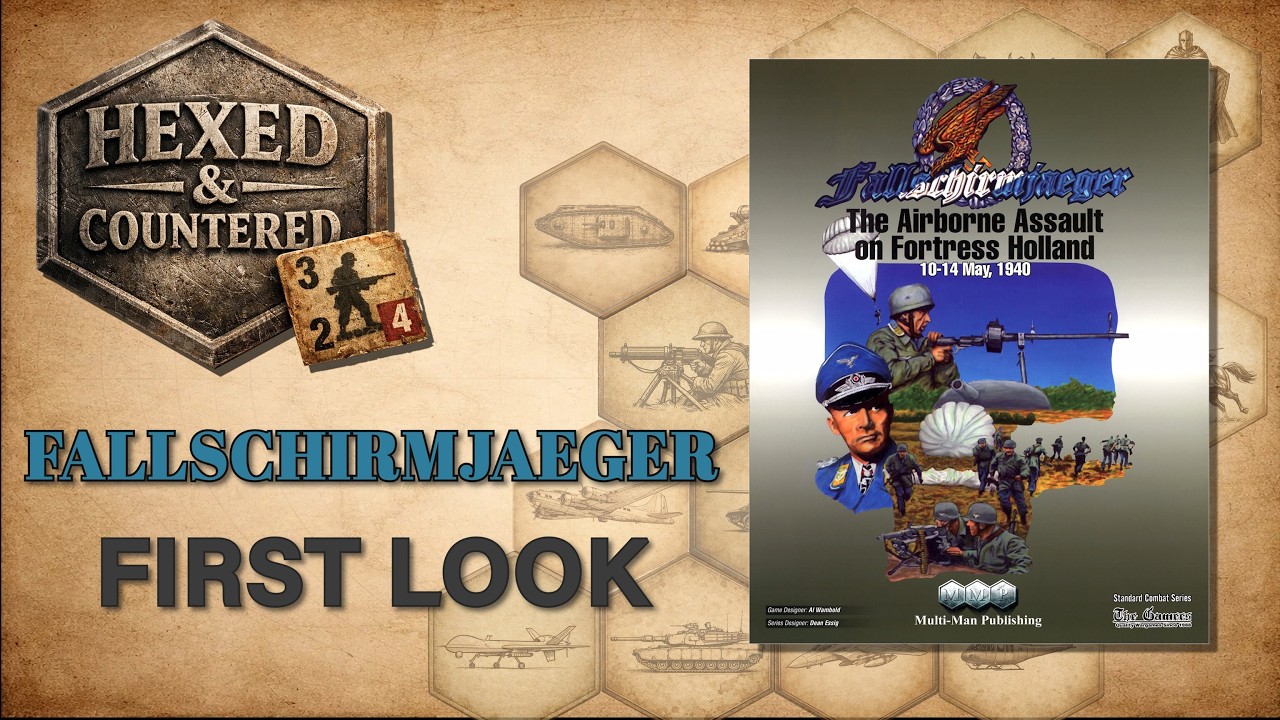
    In May 1940 the Germans tried something no one had done at scale before: seizing a country’s bridges and airfields from the sky. Fallschirmjäger: The Airborne Assault on Fortress Holland covers that gamble, and MMP has brought it back as part of the Standard Combat Series. In this first look I unbox the reprint and go through what’s in it.

    SCS speed, airborne problems

    Designed by Al Wambold on Dean Essig’s Standard Combat Series engine, this is a medium-complexity game with decent solitaire suitability — a genuinely approachable entry point into World War II tactical gaming. The box includes the version 1.8 SCS rules, the game-specific rules, 560 counters, and a 22″×34″ map, plus three scenarios: the introductory bridges at Noorderke and Dordrecht, the assault on Den Haag, and the full Fortress Holland campaign. The airborne angle is what makes it stand out — you’re landing scattered and light, and everything depends on how fast you can pull yourself together before the defenders do.

    If the Standard Combat Series is your speed, there’s plenty more here. Subscribe to keep up.

  • Tankschlacht: Cambrai 1917 (Revolution Games) — First Look

    Tankschlacht: Cambrai 1917 (Revolution Games) — First Look

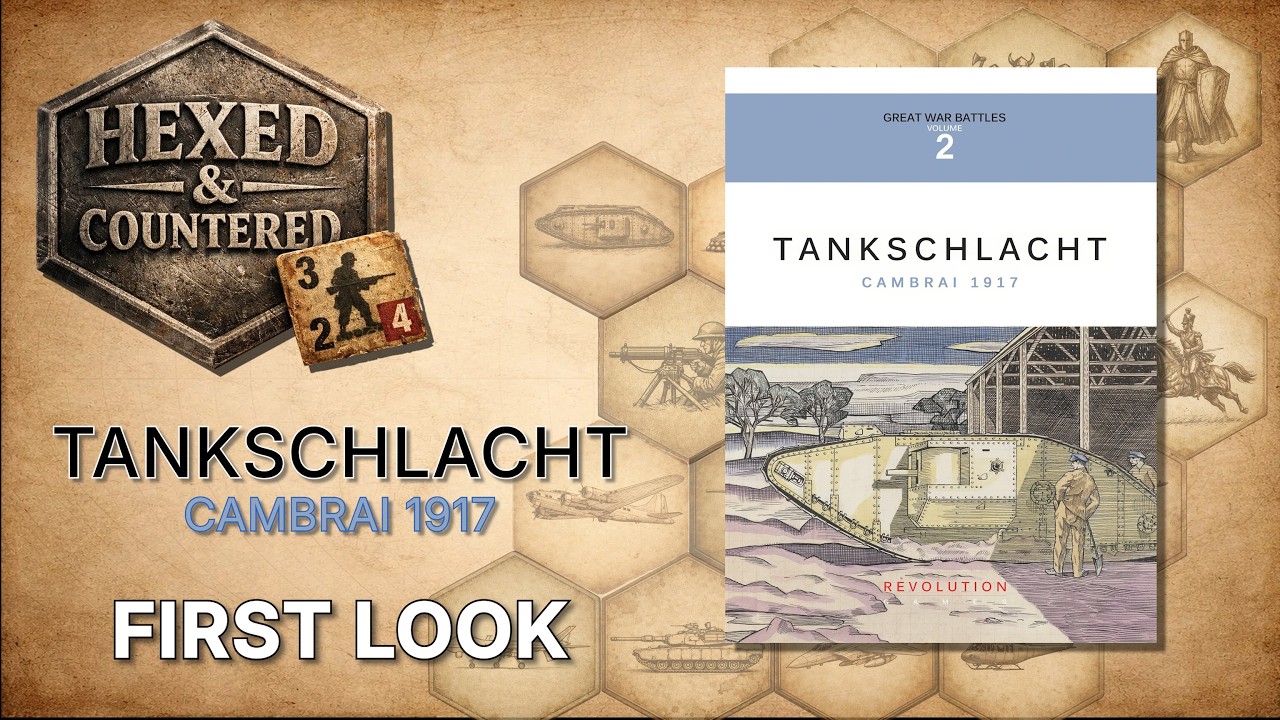
    Cambrai in November 1917 is where the tank stopped being a curiosity and started being a weapon — the first massed armored assault in history, and a preview of the way wars would be fought for the next century. Tankschlacht from Revolution Games takes on that moment, and in this first look I walk through the components and the system before diving into the gameplay series.

    The birth of combined arms

    What makes Cambrai interesting on the table is the same thing that made it interesting in 1917: tanks alone don’t win, and infantry alone can’t keep up. A good treatment forces you to coordinate the two, manage the mechanical unreliability of those early machines, and reckon with the German counterattack that erased much of the initial gain. This first look sets up how the game frames those problems; the playthroughs put them to the test.

    The full Cambrai gameplay series continues on the channel. Subscribe to follow the battle.

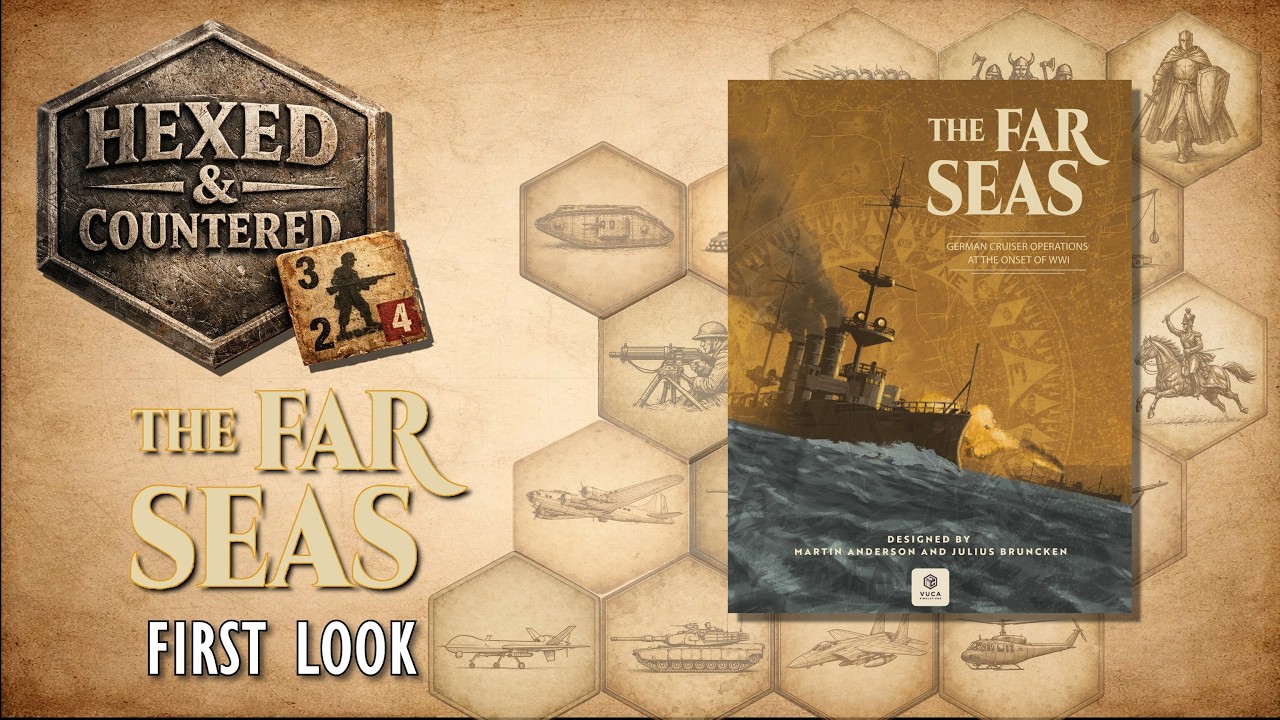
  • The Far Seas (Vuca Simulations) — First Look

    The Far Seas (Vuca Simulations) — First Look

    When war broke out in 1914, Germany had a squadron of modern cruisers on the far side of the world under Admiral Graf von Spee, with no way home and every reason to make trouble. The Far Seas, designed by Martin Anderson and Julius Brunken for Vuca Simulations, turns that opening chapter of the naval war into a solo-friendly game of raiding and pursuit. In this first look I open the box and walk the system.

    A raider’s problem

    Commerce raiding is a wonderful subject for solo play because the tension is baked in: a cruiser at large is powerful but fragile, hunted by a Royal Navy that can afford to lose ships in a way you cannot. The game hangs on coaling, intelligence, and knowing when a prize is worth the risk of being pinned down. The components look excellent, and the design offers several solitaire approaches — this first look covers the sequence of play, combat, and how the hunt comes together.

    A two-part solo playthrough follows this overview. Subscribe to sail with the squadron.

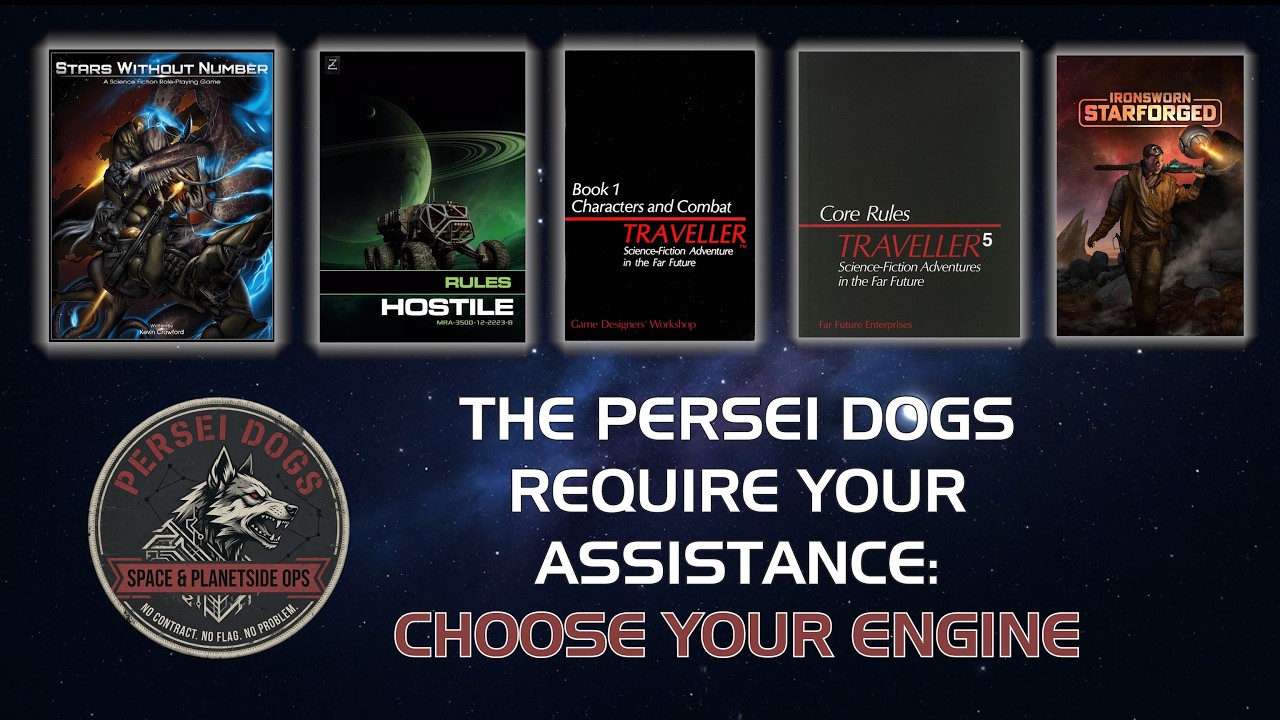
  • Picking a Sci-Fi RPG Engine: Traveller, Hostile, Stars Without Number, or Ironsworn: Starforged

    Picking a Sci-Fi RPG Engine: Traveller, Hostile, Stars Without Number, or Ironsworn: Starforged

    I want to run a sci-fi campaign for the channel, and the modern hobby is spoiled for good engines to run it on. So rather than just pick one, I laid out four contenders and put it to a vote. Each of these could carry a long-running campaign; they just get there in completely different ways.

    The four contenders

    • Traveller — the 1977 granddaddy of sci-fi RPGs. Grounded, career-driven, and built for exactly the kind of hard-edged spacefaring sandbox I keep coming back to.
    • Hostile (Zozer Games) — a blue-collar, “used future” setting in the Alien mold, running on a Cepheus/Traveller-compatible chassis. Grim, atmospheric, and perfect for survival-horror in the dark between stars.
    • Stars Without Number (Sine Nomine) — an OSR sci-fi toolkit loaded with sandbox generators. Half rulebook, half sector-building machine, and famously friendly to solo and referee-less play.
    • Ironsworn: Starforged — a PbtA-descended engine designed from the ground up for solo and co-op play, where the oracles and moves do the heavy narrative lifting.

    The honest truth is I’d be happy running any of them — but they’d produce very different shows. Traveller and Hostile lean into simulation and consequence; Starforged leans into emergent story; Stars Without Number sits comfortably between. Watch the rundown, then tell me where to point the ship.

    The winning engine becomes a full solo campaign on the channel. Subscribe so you don’t miss session one.

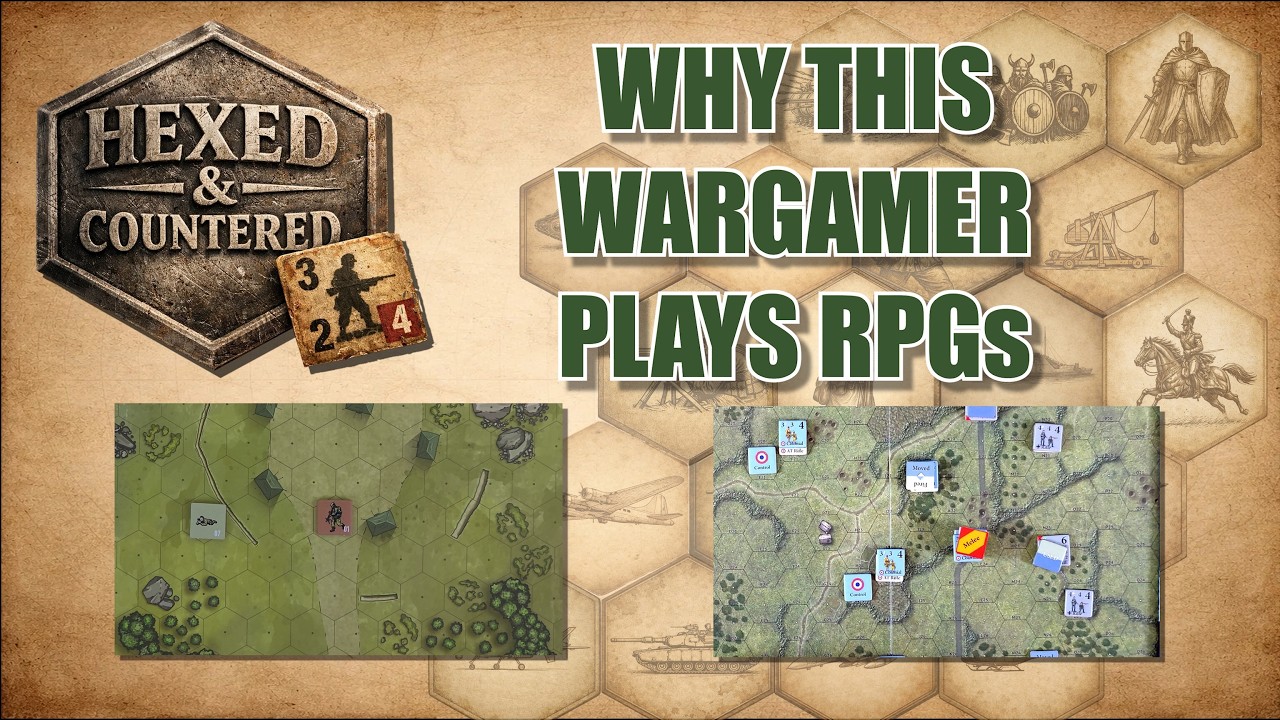
  • Why This Wargamer Plays RPGs (and Why You Might, Too)

    Why This Wargamer Plays RPGs (and Why You Might, Too)

    After forty-odd years of pushing cardboard counters across hex maps, I didn’t expect roleplaying games to grab me the way they have. But the longer I play, the clearer the throughline gets. The things that make a great wargame — meaningful decisions, real consequences, and a system that models something true — are exactly what a good RPG delivers. It’s just pointed at people instead of armies.

    Same instincts, different scale

    Wargaming trains you to read a situation: weigh the odds, spot the decisive point, and accept that a plan only survives until contact. An RPG asks a smaller, sharper version of the same question — not “where does the division attack,” but “what does this person do next, and what does it cost them.” If you already think in terms of tempo, risk, and consequence, you’re most of the way there.

    Solo play is the bridge

    I came to RPGs the way a lot of wargamers do: through solo play. A solo session of Traveller or Twilight: 2000 scratches the same itch as a solo wargame. You set the situation, the system pushes back, and the story falls out of decisions made under pressure. No group to schedule, no table to referee — just you, the rules, and the dice telling you how badly your clever idea went.

    The systems I keep returning to lean tactical for exactly that reason. Traveller and Twilight: 2000 reward planning, logistics, and knowing when a fight isn’t worth having. Those are grognard instincts, and they translate cleanly.

    If you’ve been wargaming for years and quietly told yourself RPGs “aren’t for you,” this is the video where I make the case that they might be. Give it a watch, then come argue with me.

    Hexed & Countered covers solo-friendly wargames and RPGs — first looks, full playthroughs, and campaign journals, several times a week.

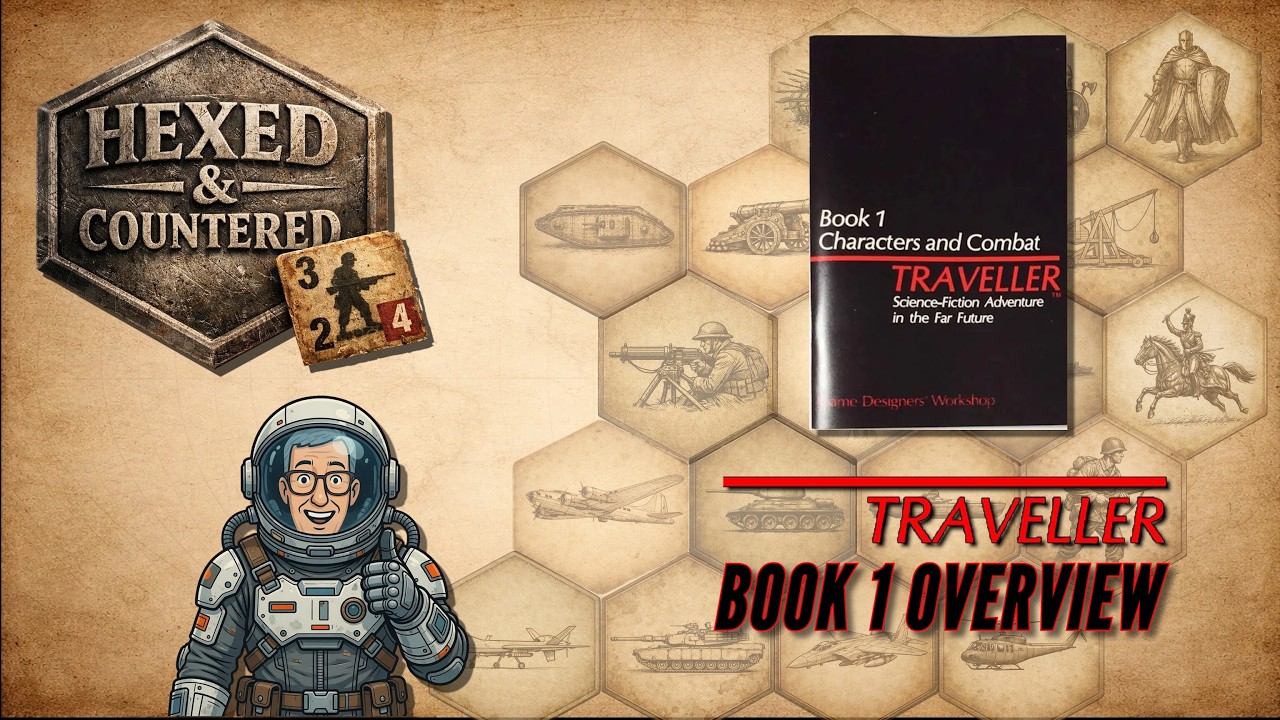
  • Classic Traveller and the Little Black Books: Where It All Started

    Classic Traveller and the Little Black Books: Where It All Started

    Before there were splatbooks and boxed sets the size of a footlocker, there were three slim black digest booklets from Game Designers’ Workshop. Published in 1977, Traveller is one of the oldest roleplaying games still in print, and the original “Little Black Books” are where the whole sprawling universe begins. In this one I open Book 1 — Characters and Combat — and look at how much game GDW packed into so few pages.

    A career before the campaign

    Traveller’s character generation is the part everyone remembers, and for good reason. You don’t just roll a spacer — you play out a prior career, term by term, gaining skills, mustering-out benefits, and a personal history before the first session ever starts. In the 1977 rules that history could end early and permanently: fail the wrong roll and your character died in chargen. It sounds brutal, and it is, but it’s also the clearest possible statement of what the game is about. Choices have weight, and the universe doesn’t owe you a happy ending.

    Why it still holds up

    What strikes me going back to Book 1 is how lean and usable it is. The combat is quick, the skill list is tight, and the whole thing assumes an intelligent referee rather than a rule for every situation. For a solo player that’s a feature: the system gets out of the way and lets the situation do the talking. If you’ve only met Traveller through its later, heavier editions, the original booklets are worth the trip back to the source.

    This is the first of an ongoing look at Classic Traveller and the wider GDW library. Subscribe to follow the series.

  • Second Season Pro Football (PLAAY Games) — Gameplay

    Second Season Pro Football (PLAAY Games) — Gameplay

    PLAAY Games has a house style, and it’s a good one: their sports sims are built to narrate. You’re not just resolving plays, you’re getting momentum swings, star performances, and the occasional back-breaking turnover, all delivered with a broadcaster’s sense of drama. Second Season Pro Football is their gridiron entry, and in this one I take it onto the field for a full look at how it plays.

    Fast, but with a pulse

    The trick with a football sim is pace. Model every play in full and a game takes an evening; abstract too hard and it stops feeling like football. PLAAY’s approach keeps things moving while still leaving room for the coaching decisions that matter — when to gamble on fourth down, when to take the clock into your own hands. If you like your sports gaming solo and story-driven, this is a system worth a look.

    More PLAAY playthroughs and solo sports gaming on the channel. Subscribe to follow the season.

  • Red, White & Blue Racin’ (PLAAY Games): The 1995 SCRAM Season

    Red, White & Blue Racin’ (PLAAY Games): The 1995 SCRAM Season

    Motor racing is a natural fit for solo gaming — a long season, a points chase, and the week-to-week soap opera of who’s hot and who’s blown an engine. Red, White & Blue Racin’ from PLAAY Games captures that in their trademark storytelling style, and here I drop the flag on a full 1995 SCRAM season to see how a campaign comes together.

    The season is the game

    A single race is fun; a season is a story. What makes racing sims tick is the arc — the standings that build week over week, the rivalries that develop, and the gamble of pushing a fragile car for a few extra points. This is the setup and season introduction, laying the groundwork for the campaign to come. If you like sports gaming with a narrative through-line, buckle in.

    The full SCRAM season plays out race by race on the channel. Subscribe to follow the standings.

  • Atlantic Chase Review – An Innovative Naval Wargame

    Atlantic Chase Review – An Innovative Naval Wargame

    ATLANTIC CHASE REVIEW

    This is the Hexed & Countered review of the 2nd printing of the game Atlantic Chase, designed by Jerry White and published by GMT Games. The game debuted in 2021 and quickly sold out, a sure sign of a good game. It took under two years for a P500 reprint to appear, which is something of a “blink of the eye” in P500 terms (some of those can run a lot longer, to the frustration of many a grognard). I was one of the P500 backers and was thrilled to finally get the game in my hands. After playing it, I’m ready to provide a review and if you’re one of those “Too long, didn’t read” types, the bottom line is that this is a fantastic game.

    First, a little background: Atlantic Chase is an operational-level game of – you guessed it – the Battle of the Atlantic during the Second World War. It pits the British Royal Navy against Germany’s Kriegsmarine. The focus is on the surface forces; British submarines, German U-Boats and both sides’ air assets all play a role, but that role is decidedly one of support and not a starring role.

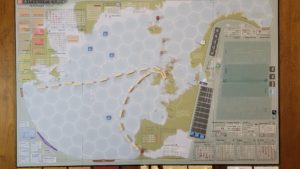
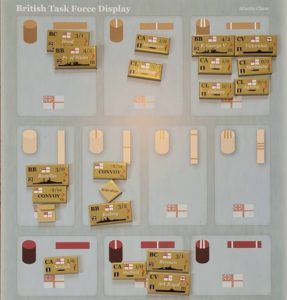
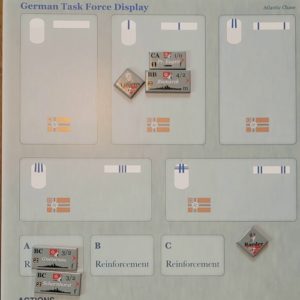
    The map is a large, hex-based map covering the North Atlantic from the coast of North America to the western Baltic and from the Arctic Circle to the fringes of the South Atlantic – which covers a lot of open water. One of the first things that show Jerry White’s innovative design is that the game’s primary counters – the ships themselves – do not live on the map but rather on task force displays, 8.5 x 11 inch cards. The British card has space for ten task forces and each has a color and a band on it to identify that task force while the German display has space for five task forces. Both sides’ displays also include reinforcement boxes.


    INNOVATIVE FOG-OF-WAR

    So what is on the map? Wooden bits – cylinders and then rectangular blocks – represent the task forces on the map. The cylinders are called “stations” and represent a ship’s known location in space & time. That is, we – both players – know that this task force (which can be one ship or several) is in that hex. The rectangular pieces are trajectory segments and this is where that innovation really becomes apparent. Trajectories represent a “we know the task force is somewhere along this path, but are uncertain where exactly that is” – it’s fog-of-war but in a new way based on the concept of a string on a map in a war room, perhaps one where Churchill stares at it in his inimitable bulldogish way, cigar clamped between his teeth. And that string? It not only represents the enemy’s ships, but also your own. It is a rather clever way to provide limited information to the player while still allowing the player to plan and act on said information.

    Key to this is the length of the trajectory – longer means you have less idea where the task force actually is – shorter means your information is getting better. This impacts the actions you take upon the trajectories with actions involving longer trajectories being more apt to be unsuccessful. Actions involving forces with shorter trajectories, or better yet, stations with a known location, are much more likely to be successful.

    OUT THERE… SOMEWHERE

    There are nine possible actions that you can take – when you have initiative, that is. These run the gamut from utilizing air and stealth forces like submarines and mines to searching for the enemy, attempting to engage the enemy or just “completing” a trajectory to get it safely into port. Setting up for, and using these actions correctly are absolutely vital to success. Yes, you need to roll dice ultimately as is the case in many wargames, but your chances are significantly improved by performing actions in the right sequence, at the right time and on the right trajectories to get the result you’re seeking. Every action is harder when employed on long trajectories and easier to successfully pull off when the trajectories are short. And you can shorten trajectories in a variety of ways, most of which also have the side effect of shortening your own trajectories, which makes the enemy’s information more precise and therefore more advantageous. Initiative changes in a variety of ways, depending on the actions the player currently holding it takes. And it is important because as the inactive player, you are limited in what you can do and sometimes have to watch as your enemy hones in an all-important task force, wrecking your plans. All in all, this is an extremely clever system.

    You’ll end up with trajectories crossing each other – or at least intersecting – as you attempt to nail down the enemy while hopefully not getting yourself in a bind doing so. For the Germans this is often a precarious task. The Kriegsmarine has limited resources and needs to be both bold and careful, which is a tightrope act of the first magnitude. The Royal Navy’s task isn’t easy either, it has convoys to protect and they are often vulnerable with rules that (rightly) prevent the player from loading up a convoy with an escort of big, powerful ships – in most cases you’re limited to one ship as an escort and this can range from a destroyer squadron to a battleship (or even potentially an aircraft carrier though that in itself would be risky).

    The game does an excellent job of portraying the real-life cat and mouse nature of the Battle of the Atlantic. There are mechanics for intel, evasive action, contact between forces that proves indecisive. The battle game is fairly simple, but mechanically sound and for those who want more meat on the bone, there is a set of advanced battle rules that make things more realistic.


    SCENARIOS GALORE

    The folks who will be interested in this game are likely familiar with the real-life history of this battle, the chase and sinking of German raiders such as the Graf Spee and the most famous of all, the search for, and ultimate destruction of, the Bismarck. And yes, there are scenarios that feature both the Graf Spee and the Bismarck. The game includes a slew of scenarios covering the course of the war from the early days of September 1939 when the British and French fought together all the way through the year 1942 when France was occupied and the Soviet Union and United States had joined the Allied cause and Britain no longer fought alone. There are solitaire scenarios, two-player scenarios and even a campaign game where you build and marshal your forces, with things carrying over from operation to operation (each operation in the campaign typically covers one year, with their being two of them later in the war).

    For the solo player, this is a real gold mine. Not only is there a booklet full of solitaire scenarios, but each has a crafted AI “bot” which utilizes tables and scenario specific rules to manage the enemy forces, but all of the two-player scenarios and campaign are also eminently playable solitaire. Just simply manage both sides to the best of your ability – something most of us have done many times.


    THE BOTTOM LINE

    In summation, I can not recommend this game highly enough. It does an incredible job of managing the uncertainty, or “fog of war” of the Battle of the Atlantic in a fresh and innovative way that simply works. Weather plays a role, utilization of support assets is important and making the right decisions with your forces is crucial.
    Atlantic Chase - The Main Board

    British Task Force Display

    German Task Force Display


    ATLANTIC CHASE Videos

    Videos on ATLANTIC CHASE from GMT Games

    A first look video and two playthrough videos.


  • Review: Carrier Battle: Philippine Sea

    Review: Carrier Battle: Philippine Sea

    A SOLITAIRE WARGAME Direct Hit


    Carrier Battle: Philippine Sea is a fantastic solitaire wargame that offers a challenging and immersive gameplay experience. Designed by Jon Southard, this game is a sequel to the venerable & popular Carrier from Victory Games which was released back in 1990, but with a focus on the historic battle of the Philippine Sea. One of the strengths of the game is how it breaks down its mechanics into manageable pieces through programmed learning, making it accessible for players to learn and master.

    The game’s scenario booklet provides a tutorial-style approach, with the first five scenarios serving as tutorials that introduce players to different aspects of the game mechanics. For example, in scenario one, players learn the rules of air-to-air combat through an interception of incoming Japanese planes by US fighter planes. This approach of breaking down the core mechanics into separate scenarios makes it easier to understand and learn the game as a whole.

    One of the core mechanics of the game is carrier flight deck operations, which is covered in scenario three. Managing the carriers correctly, including ensuring the right aircraft are on deck and ready for launch, becomes crucial for success in the game. Players need to carefully plan and execute their carrier operations, as the enemy attacks in waves and can cause damage or loss to the carriers if not managed effectively. This adds depth and strategy to the gameplay, making it engaging and challenging.

    Search and location of enemy task forces are also important aspects of the game, as covered in scenario four. The game provides different levels of intelligence on enemy forces, and players need to carefully plan their search and detection strategies to locate and engage the enemy effectively. This adds a layer of realism and decision-making to the gameplay, keeping players engaged and strategizing throughout the game.

    The rule book of the game may be lengthy, but the game’s mechanics are reasonably straightforward and easy to understand. The programmed learning approach used in the tutorial scenarios helps players grasp the different aspects of the game gradually, making it accessible to both experienced wargamers and newcomers to the genre.

    The post-tutorial scenarios offered in the game include individual scenarios for both days of the battles, a full-on two-day scenario and an alternate history offering called the “Great Battle of the Pacific” that includes ships that had been sunk in earlier fighting and also boosts the performance of the Japanese aircrew, which had by this time been severely diminished in skill due to pilot losses. The game also features a detailed and immersive setup of enemy forces, Butai displays, and management of Japanese carriers, adding depth and complexity to the gameplay.

    The game also includes US submarines, which played a vital role in the battle as well as rules for surface battles – part of the American Task Force 58 included Task Group 58.7 which was the battle line group and featured iconic ships such as the USS Iowa, while the Japanese forces included the Yamato, the largest battleship in the world.

    In summary, Carrier Battle: Philippine Sea is a well-designed solitaire wargame that offers a challenging and immersive experience. The programmed learning approach, manageable pieces of mechanics, and strategic depth make it enjoyable to play and learn. Whether you are a seasoned wargamer or new to the genre, this game is a must-try for any fan of tabletop wargames.

    Featured Videos

    Video content for Carrier Battle: Philippine Sea from the Hexed & Countered YouTube channel.