Tag: Flying Pig Games

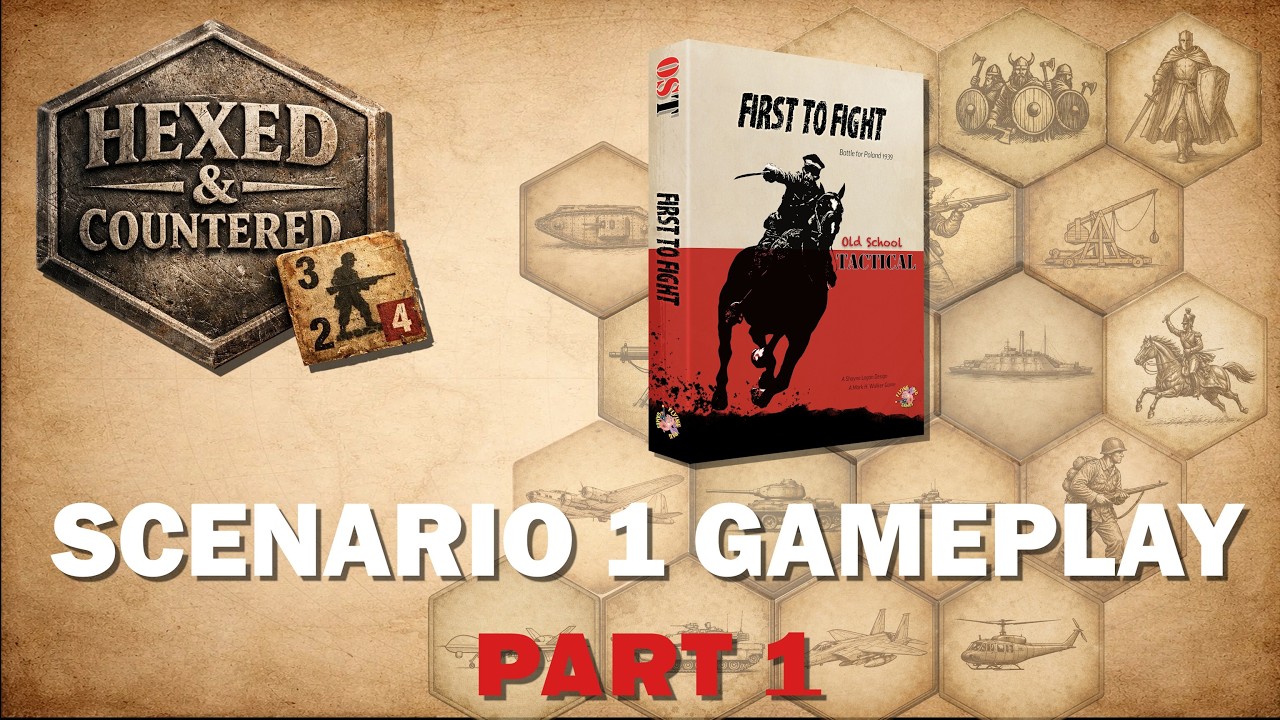
  • Old School Tactical Vol. 5: First to Fight — Scenario 1 Gameplay, Part 1

    Old School Tactical Vol. 5: First to Fight — Scenario 1 Gameplay, Part 1

    Time to get Old School Tactical Vol. 5: First to Fight onto the table. This kicks off a solo playthrough of Scenario 1 from Flying Pig Games’ Poland 1939 expansion — the opening days of the war, where a Polish garrison has to hold against the German push.

    Setup and the opening moves

    Part 1 covers the rules in play, the pre-turn setup, and the early action: hidden sniper mechanics, smoke deployment by the German pioneers, the combat calculations, and even off-board naval bombardment from the battleship Schleswig-Holstein — the very guns that opened the war at Westerplatte. It’s a good showcase of why OST stays approachable without being shallow: the fiddly bits are there, but the decisions read clearly. Part 2 follows.

    Part 2 continues the scenario. Subscribe to follow the fight for Poland.

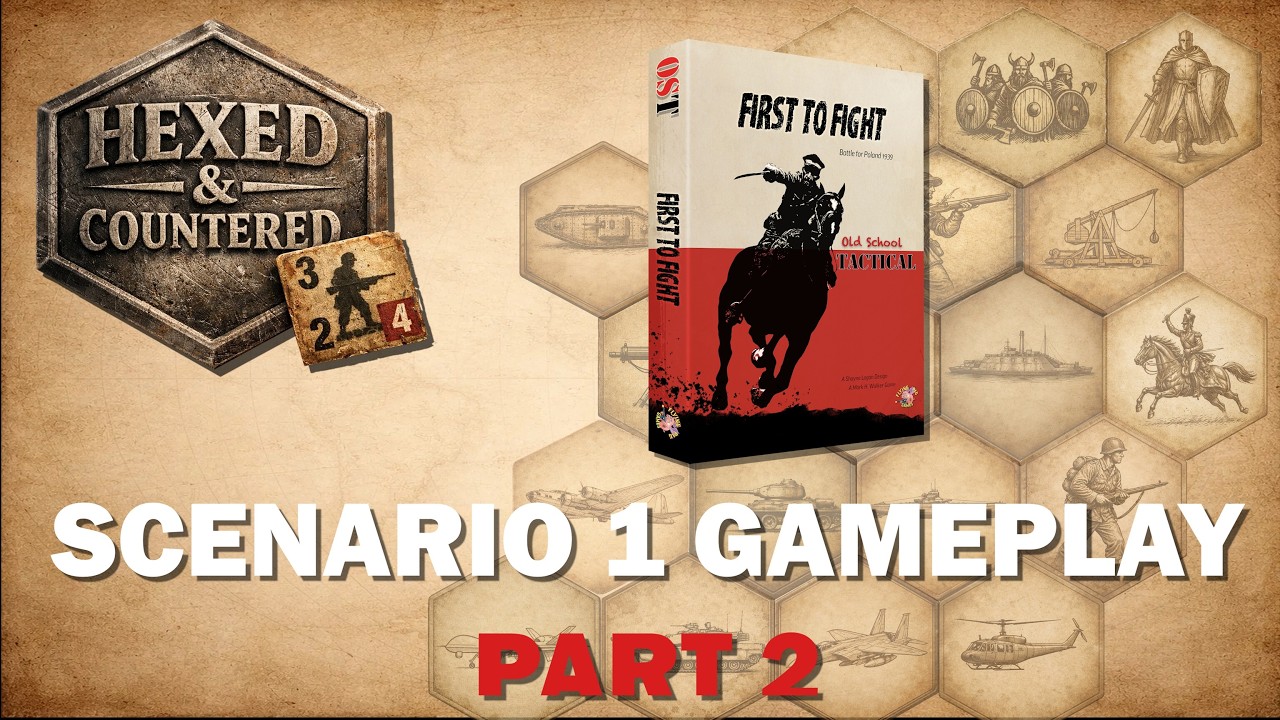
  • Old School Tactical Vol. 5: First to Fight — Scenario 1 Gameplay, Part 2

    Old School Tactical Vol. 5: First to Fight — Scenario 1 Gameplay, Part 2

    The bunker assault heats up. This is Part 2 of the Scenario 1 solo playthrough in Old School Tactical Vol. 5: First to Fight (Flying Pig Games), and the Polish defenders are not going quietly.

    Into the bunkers

    Turns 6 and 7 push the German forces forward against determined resistance. Hidden snipers spring their ambushes, pioneer squads lay down smoke to cover the advance, and the fighting collapses into brutal close-combat melees around the fortified structures and bunkers. This is squad-level tactics at its most tense — the kind of grind where a single bad activation can stall an entire assault.

    Start with Part 1 if you missed it, and subscribe for more OST.

  • Old School Tactical Vol. 5: First to Fight — Scenario 1 Gameplay (Part 1)

    Old School Tactical Vol. 5: First to Fight — Scenario 1 Gameplay (Part 1)

    A first look tells you what’s in the box; a playthrough tells you whether the thing actually works on the table. This is Scenario 1 of Old School Tactical Vol. 5: First to Fight – the Battle for Poland 1939 played solo, and it’s where Flying Pig Games’ tactical system meets the opening days of the war.

    Setting up Scenario 1

    I walk through the rules and the pre-turn setup before the shooting starts, and Poland 1939 brings some specific wrinkles worth slowing down for. Hidden sniper mechanics keep the Polish defender dangerous in a way you can’t quite see, German pioneers lay smoke to screen their advance, and there’s off-board naval bombardment from the battleship Schleswig-Holstein, a nice historical touch that also matters tactically. I take the combat calculations step by step so it’s clear how a firefight resolves rather than just showing the result.

    How it plays solo

    Old School Tactical has always been approachable without being shallow, and that holds up here. Solo, the system runs cleanly once you’ve internalized the sequence of play, and the 1939 material gives you asymmetric problems like a Polish force fighting for time against a German attack with more tools. This is Part 1, with the scenario still developing; Part 2 is where we see how the fight actually turns out. If you’ve been curious whether the Poland expansion is worth it, watching it played is the best way to judge.

    Part 2 picks up right where this leaves off. Subscribe so you don’t miss it.

  • Old School Tactical Vol. 5: First to Fight — Battle for Poland 1939 (Flying Pig Games) — First Look

    Old School Tactical Vol. 5: First to Fight — Battle for Poland 1939 (Flying Pig Games) — First Look

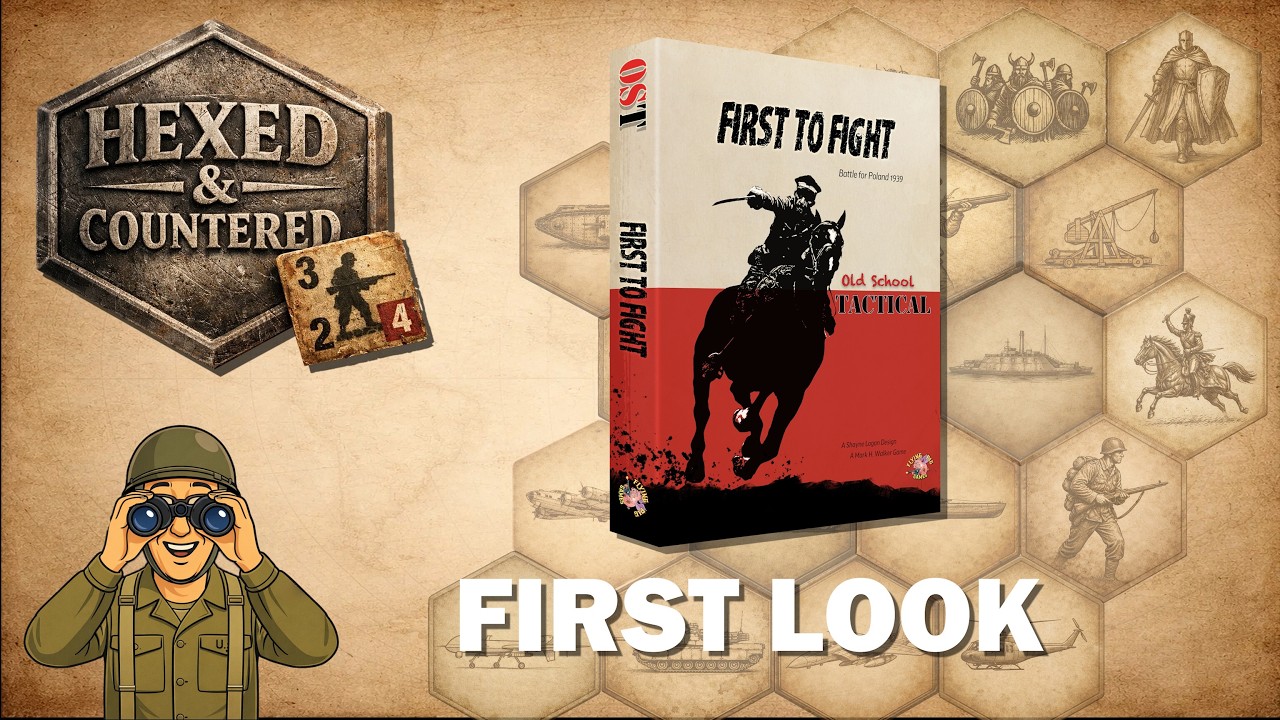
    Poland, September 1939, is where the Second World War began and where a lot of wargames never bother to go. Old School Tactical Vol. 5: First to Fight from Flying Pig Games takes the popular tactical system back to the opening campaign, and in this first look I go through the components and what the expansion adds.

    The forgotten opening

    The 1939 campaign is more interesting than its reputation suggests — the Polish army was not the pushover of popular memory, and the early-war mix of tankettes, cavalry, and improvised defense makes for a very different tactical puzzle than the mid-war battles the system usually covers. Old School Tactical is known for being approachable without being shallow, and this first look sets up how the Poland material plays inside that framework.

    Scenario playthroughs follow this overview. Subscribe to see it hit the table.

  • Review: ’65: Squad-Level Combat in the Jungles of Vietnam

    Review: ’65: Squad-Level Combat in the Jungles of Vietnam

    65-ANZAC Counters

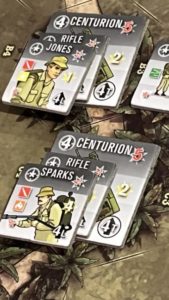
    Some Aussies riding into a VC-controlled village in style on a couple of Centurion tanks
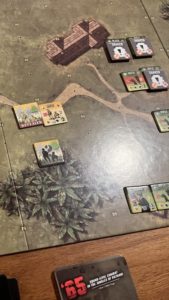
    The solitaire mode is both creative and a challenge. The cards drive the action and determine what the enemy does during its impulse.

    The City map – chock full of tactical opportunities across rice-paddies, cemeteries, large and small buildings, and of course – plain ol’ jungle.

    “I really wanted to do my best Arnold impersonation and bellow ‘Get to the choppahs!’
    – but I restrained myself.”

    SUBHEADING

    TIME TO ROCK IT FROM THE DELTA TO THE DMZ…

    If you don’t recognize the little snippet above, it’s from the 1988 Robin Williams film “Good Morning Vietnam” – and I reference it because just as the words uttered by Williams’ character Adrian Cronauer (a real guy by the way) cover the length of the country of South Vietnam, so does Flying Pig Games’ “’65: Squad-Level Combat in the Jungles of Vietnam” offer a wide-ranging plethora of tactical scenarios during the Vietnam War.

    Designer Mark H. Walker, the man behind Flying Pig Games needs no introduction to grognards. His creds vis-a-vis tactical wargame systems is about as legit as they come. After all, he is the guy behind Lock ‘n Load Tactical, World at War ’85 and Nations at War. He’s also written a bunch of books and now runs two game companies: the aforementioned Flying Pig Games and also Tiny Battle Publishing. 

    The card-driven system Walker employs in ’65 owes its lineage to a game called “Night of Man” which Flying Pig Games released in 2015. That one covered an alien invasion and though I’ve never played it, after playing ’65, it would be safe to say that I am more than a little intrigued about its predecessor.

    The system that drives Night of Man – and ’65 – is as mentioned earlier, card-driven. This strips down the gameplay and makes the game both fast-moving and easily accessible. There aren’t a lot of rules to memorize, and the rulebook itself is short, to-the-point and full of examples that help newbies (or FNGs in Vietnam parlance) get started without too much heartache.

    Generally speaking each side gets a hand of four cards. There are some situations where you might have fewer (or more on at least one occasion). These cards allow actions to be performed. The basics being move and fire, though there are various “types” of actions that cover those two categories (things like Flanking Fire and Fast Move are two of the many examples).

    There are also cards that you can play to support your own action, or if the opponent is playing a card, can allow a reaction to occur. And there are card actions that allow you to rally or reconstitute units that have taken hits in combat. And yes, there is Op fire when a unit passes within the line of sight of a non-phasing unit – as long as you have a fire card.

    The card design is clever and utilitarian, as they typically contain not only two of the action/reaction/support triggers, but also two boxes that will determine the result of combat. Everything from ranged combat, to close assault, to armor and artillery is covered within these two boxes. The cards even determine when a turn ends, as there are four “End of Turn” cards and each scenario will include the number of these cards that will need to be drawn to end each turn.

    Speaking of turns, the game turns feature impulses in which the players will alternate actions with the opponent naturally being able to do things like opportunity fire or play reaction cards. Units will be marked with “Moved” or “Fired” markers after performing one of those actions, or “Ops Complete” if they have done both, or have used a “Power” – another trigger on certain cards.

    Powers – and abilities – are icons on the unit counters. These give variety to the units beyond the typical attack, movement and defense values that most games feature. The powers need to be triggered by the word “Power” on a card, while abilities (in general) are always on. Powers include things like adding firepower to an attack or making an assault more powerful. Abilities will allow units – and heroes – do things like hit multiple targets within a hex, or redraw a card to avoid a bad result, and much more. The variety of abilities and powers really highlights the differences between the units. An NVA rifle squad is not the same as a US Army squad which itself is not the same as a USMC squad, and that goes beyond just the “attack & movement” numbers thanks to abilities & powers.

    The unit mix is very nice too – you get the rifle squads, the machine-guns (M-60s and RPDs), the RPGs, the Sappers, etc. But you also get the heroes mentioned earlier, each possessing a specialized ability (or three) that makes them very valuable. And, it being Vietnam, you also get helicopters. I really wanted to do my best Arnold impersonation and bellow “Get to the choppahs!” – but I restrained myself.  There are two flavors of Hueys – the transport & gunship varieties and the USMC add-on brings some Cobra gunships with a pretty fearsome firepower.

    There are also vehicles – from the tanks (PT-76s for the NVA, M-48s for the US forces and Centurions for the ANZACs), to trucks (some toting guns) to Ontos and M-113 APCs.

    The base game is very good in its own right but when you add the expansions to the mix, the game moves to the level of great. I’m lucky enough to have all the add-ons for this game: Alone in the Jungle (the solo module), the USMC/ANZAC forces and the City map as well as the additional action cards (which add things like ‘Sudden Downpours’ with potentially turn-wrecking consequences).

    The solitaire module is brilliant. It too is card-driven (with its own deck) and the cards, coupled with scenario specific “stances” for the NVA/VC forces, provides a competent opponent. The solo add-on also brings some random events and extra terrain tiles to the mix, as well as six scenarios designed for the solo mode. My opinion, which – full disclosure, I have yet to test – is that the base scenarios could, with a little work, be adapted to work with the solo rules.

    The USMC/ANZAC expansion brings not only the forces of the title organizations, but also new abilities – flamethrowers, anyone? – and powers that really help differentiate the Aussies, the Kiwis and the Corps.

    Then there’s the City map – big, dark and chock full of tactical opportunities thanks to many buildings, rice paddies, cemetery hexes, bridges spanning a river that rolls across the map and even the ubiquitous jungle. I played the city scenario and it was a blast.

    About the only thing missing in this game is air power. Sorry guys, no “Puff the Magic Dragon” or Phantoms laying down some snake n’ nape in this one. But trust me, you won’t even miss ’em.

    To sum up, this is an excellent game. Yes, it’s not new (it was released right around the end of 2016/start of ’17) and to me that makes it feel like a bit of an under-appreciated gem. The card-driven impulse-based system just works. The powers & abilities make the different units feel distinct and the scenarios (especially the solitaire ones) are both fun and filled with little touches that really make the game immersive.

    Technically out-of-print, I couldn’t recommend this more highly. If you like tactical games and can find a copy – get it.
    ReLATED Videos

    Video Series

    ’65: Squad-Level Combat in the Jungles of Vietnam

    The series covers the components, a playthrough of one of the base game scenarios, a demonstration of the solitaire expansion, partial playthrough of the USMC/ANZAC expansion (including armor) and an AAR-type playthrough (with one full turn) of the City scenario, which includes helicopters.

    For full playlist, visit the Hexed & Countered YouTube channel here